Saturday, April 28, 2007

Making Changes

"It’s easier to change one’s religion than one’s café."

I saw this sign at Baristas Café in Kolkata.
It's worth letting that thought percolate for a while.


Geoff Pound

Monty Python Divided Over Work

Michael Palin writes this entry in his diary (December 31, 1971) about differences in the Monty Python Team over their attitudes to work:

“The split between John [Cleese] and Eric [Idle] and the rest of us has grown a little recently. It doesn’t prevent us all from sharing—and enjoying sharing—most of out attitudes, except for attitudes to work. It’s the usual story—John and Eric see Monty Python as a means to an end—money to buy freedom from work. Terry J [Jones] is completely the opposite and feels that Python is an end in itself—i.e. work which he enjoys doing and which keeps him from the dangerous world of leisure. In between are Graham [Chapman] and myself.”

Michael Palin Diaries 1969-1979: The Python Years (London: Weidenfeld & Nicolson, 2006, 65.

Image: The Python Team

Friday, April 27, 2007

Woody Allen on Dealing with Differences

When Woody Allen was talking about his 11 year marriage with Mia Farrow he reflected on the challenge of seeking to manage their many differences:

“She doesn’t like the city and I adore the city. She loves the country and I don’t love the country. She doesn’t like sports at all and I love sports. She can’t sleep with the air-conditioner on. I can only sleep with the air-conditioner on. She loves pets and animals. I hate pets and animals. She would love to take a boat down the Amazon or go up to Mt Kilimanjaro. I never want to go near those places. She has an optimistic yeah feeling toward life and I have a totally pessimistic negative feeling. She has raised nine children now with no trauma and has never owned a thermometer. I take my temperature every two hours.”

No wonder they came to live in separate apartments that faced each other across Central Park in New York.

Geoff Pound

Image: Woody Allen and Mia Farrow

Thursday, April 26, 2007

Cookie Communication: Sinning Boldly?

Why ever would you print the nutritional facts on the icing of a biscuit, especially if it comes in a packet?

As an act of honesty and transparency?

To warn consumers so that they don’t buy too many?

Maybe so that people can do what Martin Luther spoke about when he said, “If you’re going to sin, sin boldly.”

What fun, being able to lick these details off about calories and fat, on a biscuit or three.

Geoff Pound

Image: Eating the truth.

Fiddler On The Roof: Why are we doing this?

In ‘Fiddler on the Roof’ there is a Passover scene in which the mother and father gather all the children dressed in their best clothes. The table is set with everything in its rightful place then the children ask the question, “Why are we doing this?” Their eyes, especially those of the younger ones say, “I don’t understand. “Why do we go to all this trouble?”

The answer, in the parents’ eyes and in everything they are doing, is “because we are Jews.” They are Jews in Russia. They are in danger but they will never forget the fact that they are Jews. They do this, all this, to remember who they are. They do it because their fathers and mothers did it before them beginning at a time when they too were too young to understand it fully.

Geoff Pound

Image: Cast from Fiddler on the Roof

Wednesday, April 25, 2007

Michael Palin Goes to Church

Michael Palin writes in his diary, Sunday February 28, 1971:

I had been feeling guilty for some weeks that I had made no effort to follow up my decision to have William [his son] christened at St. Martin’s, the local church standing amongst the rubble of the Gospel Oak rebuilding scheme.

And today I took the snap decision to go. I was literally summoned by the bells. It was a strange feeling going into a church I did not know for a service that I did not really believe in, but once inside I couldn’t help a feeling of warmth and security. Outside there were wars and road accidents and murders, striptease clubs and battered babies and frayed tempers and unhappy marriages and people contemplating suicide and bad jokes and The Golden Shot [a British television game show between 1967 and 1975], but once in St. Martin’s there was peace. Surely people go to church not to involve themselves in the world’s problems but to escape from them. And surprisingly also, here in the middle of devastated Kentish Town, was a large unusually designed stone building, with polished pews and shining brass and a vicar and faithful people gathered. Though rationally I would find it difficult to justify my participation, I nevertheless was glad I went. In a funny way, I was really moved by the faith of the fifteen old ladies, four men, a choir (black and white) who were there with me. But seeing the vicar afterwards I felt a fraud.

Michael Palin Diaries 1969-1979: The Python Years (London: Weidenfeld & Nicolson, 2006, 55-56.

My review of this book can be found at Reviewing Books and Movies.


Geoff Pound

Image: St Martin’s Gospel Oak. The web site says that, “the church has recently been restored. Come and see.”

Tuesday, April 24, 2007

The Wright Way to Develop a Vision

On December 17, 1903 at 10.35am Orville Wright secured his place in history by executing the first powered and sustained flight from ground level. For twelve gravity-defying seconds he flew 120 feet along the dunes of the Outer Banks of North Carolina.

In the field of aviation, this historic event represented a beginning. But for Orville and Wilbur Wright, it was the end of a long and tedious journey. A journey initiated by a dream common to every little boy. The desire to fly. But what most children abandon to the domain of fantasy, Orville and Wilbur Wright seized upon as a potential reality. They believed they would fly. More than that they believed they should fly.

Wilbur described the birth of their vision in this way:

“Our personal interest in it [aviation] dates from our childhood days. Late in the autumn of 1878, our father came into the house one evening with some object partly concealed in his hands, and before we could see what it was, he tossed it into the air.”

“Instead of falling to the ground, as we expected, it flew across the room until it struck the ceiling where it fluttered for a while and finally sank to the floor. It was a little toy, known to scientists as a ‘hélicoptère’ but which we with sublime disregard for science, at once dubbed a ‘bat’.”

“It was a light frame of cork and bamboo, covered with paper, which formed two screws, driven in opposite directions by rubber bands under torsion. A toy so delicate lasted only a short time in the hands of small boys, but its memory was abiding.”


(Orville and Wilbur Wright, “The Wright Brothers Aèroplane,” Century Magazine, September 1908.)

This childhood experience sparked in the boys an insatiable desire to fly. The only thing they lacked was the means. So they immediately went to work removing the obstacles that stood between them and their dream and they began building their own helicopters. In doing so they stumbled upon the principles of physics that could pave the way to their first successful manned flight. In short they began to engineer their vision. They took the necessary steps to ensure that what they believed could be, would be..

Andy Stanley, Visioneering (Sisters Oregon: Multnomah Publishers, 1999), 7-8

Image: Orville (left) and Wilbur Wright.

David Halberstam: A True Professional

David Halberstam, the Manhattan-based Pulitzer Prize-winning journalist and author of books on many topics was killed yesterday in a car crash at the age of seventy-three.

In the recent interview, Mr. Halberstam summed up his approach to work by quoting a basketball player. “There’s a great quote by Julius Erving,” he said, “that went, ‘Being a professional is doing the things you love to do, on the days you don’t feel like doing them.’ ”

Clyde Haberman, ‘David Halberstam, 73, Reporter and Author, Dies’, New York Times, April 24, 2007

Image: David Halberstam

Monday, April 23, 2007

Look at the Birds of the Air

Many people cannot walk through a forest to do bird watching but the Collaborative Observatory for Natural Environments (CONE) Sutro Forest is a new bird watching project in which you can participate from your computer.

An ultra-high resolution telerobotic camera is mounted outside a home that overlooks San Francisco's Sutro Forest.

You can log on to observe birds, take photos, and identify the different species.

Here is the link to look at the birds.

Geoff Pound

Image: Birds at the feeder of the CONE project.

Dame Edna: Showering Embarrassments

Michael Palin’s Diary entry, 23 May, 1976 after having lunch with Ian, [who collaborated on material for Barry Humphries’ stage show]:

“Ian tells a good Barry Humphries tale—apparently Barrie was in full swing as Edna in his show at the Apollo, when a man in the front row, ever so discreetly, left for a pee. But he couldn’t really escape Edna’s eye and Edna remarked in his absence and talked to his wife for a while about his waterworks. Having found out the man’s name, Edna and the audience plotted a little surprise for him. So when he duly reappeared from the gents and made for his seat, once again stealthily and soundlessly, without disturbing a soul, Edna gave a cue and as he was half-way down the gangway, the entire theatre chanted, ‘Hello Colin!’”

Michael Palin Diaries 1969-1979: The Python Years (London: Weidenfeld & Nicolson, 2006, 317.

Image: Dame Edna.

Sunday, April 22, 2007

Story for World Earth Day

On this World Earth Day I thought I would do some recycling!

Here is a story that I posted last year about a great environmentalist, John Muir.

Have another look at Engaging Life Fully.

Geoff Pound

Image: John Muir

US Building Walls in Iraq: Do 'Good Fences make Good Neighbors'?

Residents of a dangerous district in Baghdad are accusing the United States of hardening sectarian divisions as US forces wall them in behind a five-kilometre security barrier.

The walls separating Palestinian and Israeli in Israel and now Sunni and Shia in Iraq, call to mind Robert Frost’s poem that begins with these haunting words, "Something there is that doesn't love a wall.’


Mending Walls by Robert Frost

Something there is that doesn't love a wall,
That sends the frozen-ground-swell under it,
And spills the upper boulders in the sun,
And makes gaps even two can pass abreast.
The work of hunters is another thing:
I have come after them and made repair
Where they have left not one stone on a stone,
But they would have the rabbit out of hiding,
To please the yelping dogs. The gaps I mean,
No one has seen them made or heard them made,
But at spring mending-time we find them there.
I let my neighbor know beyond the hill;
And on a day we meet to walk the line
And set the wall between us once again.
We keep the wall between us as we go.
To each the boulders that have fallen to each.
And some are loaves and some so nearly balls
We have to use a spell to make them balance:
'Stay where you are until our backs are turned!'
We wear our fingers rough with handling them.
Oh, just another kind of out-door game,
One on a side. It comes to little more:
There where it is we do not need the wall:
He is all pine and I am apple orchard.
My apple trees will never get across
And eat the cones under his pines, I tell him.
He only says, 'Good fences make good neighbors'.
Spring is the mischief in me, and I wonder
If I could put a notion in his head:
'Why do they make good neighbors? Isn't it
Where there are cows?
But here there are no cows.
Before I built a wall I'd ask to know
What I was walling in or walling out,
And to whom I was like to give offence.
Something there is that doesn't love a wall,
That wants it down.' I could say 'Elves' to him,
But it's not elves exactly, and I'd rather
He said it for himself. I see him there
Bringing a stone grasped firmly by the top
In each hand, like an old-stone savage armed.
He moves in darkness as it seems to me~
Not of woods only and the shade of trees.
He will not go behind his father's saying,
And he likes having thought of it so well
He says again, "Good fences make good neighbors."

Source: ‘Iraq Residents Angered by US Wall’, Al Jazeera, 21 April 2007

Image: Proposed placement for the wall in Iraq.

Saturday, April 21, 2007

Nick Hornby: The Gift of Good Fiction

"What I’ve always loved about fiction is its ability to be smart about people who aren’t themselves smart, or at least don’t necessarily have the resources to describe their own emotional states. That was the way Twain was smart, and Dickens; and that is surely one of the reasons why Roddy Doyle is adored by all sorts of people, many of whom are infrequent book-buyers. It seems to me to be a more remarkable gift than the ability to let extremely literate people say extremely literate things."

Nick Hornby, The Complete Polysyllabic Spree, London: Viking, 2006. 161-162. A review of this book can be found at Reviewing 'The Complete Polysyllabic Spree' by Nick Hornby.

Image: “One of the reasons why Roddy Doyle is adored by all sorts of people…”

Geoff Pound

Tips from a Master Storyteller

Three recent articles giving some reasons why F W Boreham was an effective communicator and storyteller are entitled:

The F W Boreham Approach: Urging Connections

F W Boreham Shares His Greatest Secret and

F W Boreham on Communication that Connects

Geoff Pound

Image: Ever tried to communicate on the topic of window dressing? Pictured is one of the most popular shop windows in Melbourne—the Myer window at Christmas time.

Friday, April 20, 2007

Brian Lara: ‘Strength from my Parents’

At the Press Conference, at which Brian Lara announced his retirement from all international cricket, he paid tribute to the strength that his parents had given him:

"I am also proud," Lara said. "I have been knocked down so many times, as a player and as a person, and I have had the strength, I suppose that has come from my parents, to be able to pick myself each and every single time and go out there in the face of adversity and try my best and perform. I didn't read it up in a book. It's deep down and it's part of my family trait."

Source: Sambit Bal, ‘Lara and the Art of Leaving’, CricInfo, April 19, 2007.

Image: Brain Lara in action on the cricket field.

Lara and the Art of Leaving

In his report on the West Indies v Bangladesh game in the Cricket World Cup on 19 April, Sambit Bal writes about Brian Lara and the art of leaving:

“You could never accuse of Brian Lara of lacking in timing. And if his retirement announcement was made without customary flourish, it didn't lack drama. It was the most delectable of late cuts: perfectly conceived and deftly executed, it left those in its presence breathless.”

“There was no gasp, because it took time to register. He dropped it in casually, just after he had finished answering his last question and when notebooks were being put away. He leaned forward, almost as if he was preparing to leave, and whispered these words into the microphone: "I gave extensive consideration to this. I want everybody to know that on Saturday I'll be playing my last international match."

“Journalists turned around and looked enquiringly at each other. Did I hear it right? Did he say merely international or was there a one-day before it. Some rushed to the dais to confirm it with Imran Khan, the West Indies media manager, who nodded his head. Some shoved miniature bats and notebooks to be autographed. But Lara had made it clear that there would be no further questions, and none were asked.”

Sambit Bal, ‘Lara and the Art of Leaving’, CricInfo, April 19, 2007.

Image: Brain Lara leaves the international field in the match between the West Indies and Bangladesh at Barbados, April 19, 2007.”

Beatrix Potter: Daring to be Courageous

This story about calling a spade a spade, concerns Beatrix Potter (1866-1943), the English author of The Tale of Peter Rabbit, The Tale of Benjamin Bunny, and other children's books:

"In 1912, by which time Beatrix Potter, the author of The Tale of Peter Rabbit, was a hugely successful forty-six-year-old writer and illustrator, she sent her publisher Harold Warne a new story, her darkest yet, called The Tale of Mr. Tod. The story is about an argument between a fox and a badger, and features the abduction and near death of a sackful of baby rabbits. The story had a particularly good opening sentence: 'I am quite tired of making goody goody books about nice people.'

But the candor and acerbity of that were too much for Warne, and he fussed until Potter agreed to change the opening to something inarguably less punchy: 'I have made many books about well-behaved people.' Before she succumbed to this bad editorial advice, Potter relieved herself of her feelings in a letter to Warne:

"'If it were not impertinent to lecture one's publisher, you are a great deal too much afraid of the public for whom I have never cared one tuppeny-button. I am sure that it is this attitude of mind which has enabled me to keep up the series. Most people, after one success, are so cringingly afraid of doing less well that they rub all the edge off their subsequent work.' "

"The world's most popular children's author had a low opinion of both books and children: 'I never have cared tuppence either for popularity or for the modern child; they are pampered & spoilt with too many toys & books.' ...

"Potter's work was always tinged with a bleak realism about death, right from the opening of The Tale of Peter Rabbit, in which we learn that Peter's father has had 'an accident' and ended up in one of Mrs. McGregor's pies. ...

"Even in the lighter stories, such as Two Bad Mice, the main characters experience 'no end of rage and disappointment,' and that is before we encounter the outright evil of the fox in The Tale of Jemima Puddle-Duck, who encourages Jemima to pick the flavorings and seasonings in which she is to be cooked—a gesture of macabre cruelty which would give pause to Hannibal Lecter.

"This darkness and violence is a central reason to why children like Beatrix Potter. Her bright, brisk, no-nonsense sentences, her sharply observed and beautifully tinted images, and her strong feeling of coziness and domesticity are all underpinned and made real by underlying intimations of darkness, cruelty, and sudden death."

Source: John Lanchester, "The Heroine of Hill Top Farm," The New York Review of Books, March 15, 2007, p. 25.

This excerpt came (7/3/07) from the very good web site, Delancey Place.Com, which sends subscribers an article each day.

Image: “But Peter [Rabbit], who was very naughty, ran straight away to Mr. McGregor's garden, and squeezed under the gate!”

Federer and Nadal Serve up a Lesson in Conflict Resolution

How do you go about resolving your differences when one person or party prefers one thing and the other prefers another?

The solution for has come from an unlikely quarter—the two champion male tennis players in the world.

Four-time Wimbledon champion, Roger Federer, is the world’s best player on grass courts while Rafael Nadal has won the last two French Open titles and has a 64 winning streak on clay. Which player is the best? It depends on what type of court they are playing.

A special exhibition match has been arranged for these two to settle their differences and decide who is the greatest. The game will be played on 2 May in Mallorca, Spain, where Nadal was born.

For the first time in history the court will be half grass and half clay. The characteristics of the match will be normal. That is, it will be played to the best of three sets with the usual changes of side, in uneven games.

Dubbed “the battle of the surfaces”, this initiative began with an idea by Pablo Del Campo, president of Del Campo Saatchi & Saatchi.

The idea has already met with widespread support as this fun game is a sell out.

This proposal has far-reaching implications for any people who are wanting to resolve their surface differences.

Geoff Pound

Image: Nadal and Federer.

Change Your Name or Change Who You Are

The army general, Alexander the Great, was known to be strict with his soldiers.

One night a soldier was found asleep on his guard duty. This was a serious offence and he had to appear before his commander.

Alexander was seated on his horse, the charge was read out and the soldier was asked, “What is your name?” The soldier said, “Alexander.”

The general was furious and he asked again, “What is your name?”


After the confirmation the general leant over and said, “Young man, either change your name or change who you are."

Geoff Pound

Image: Alexander the Great

Thursday, April 19, 2007

Clinton and the Role of Humour

Using humour, US President Bill Clinton conceded things in his speeches that he had never acknowledged anywhere else.
Clinton never called a press conference to concede that his administration got off to a rocky start, despite fiascos such as the issue of gays in the military, a rejected economic stimulus package and a $400 haircut.

But when his first appearance at the White House Correspondence coincided with his first one hundred days in office, the President joked to the White House press corps: "I don't think I'm doing that bad. On the 100th day after his inauguration, William Henry Harrison was already dead for 68 days."

Image: Bill Clinton

"We Shall Die Before We Kill!"

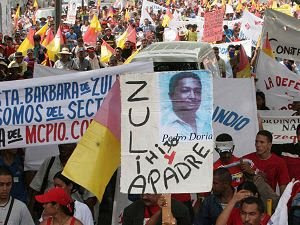
Two leaders, in similar positions, can deal with conflict in very different ways. This is true in every conflict, whether the stakeholders are highly educated university officials or uneducated peasants.

The campesinos who live along the Carare River in the jungles of Colombia are ordinary people without academic degrees or training. Yet when they were ordered by a general in the army to take up weapons against the guerillas (i.e. to take one side against another), they refused to be forced against their will into a civil war and were determined to live in peace. Committed to nonviolence (their slogan: "We shall die before we kill!"), they beautifully articulated the power of an integral vision. Its principles included the following:


• Faced with silence and secrecy: do everything publicly.
• Faced with fear: be sincere and dialogue.
• Faced with violence: talk and negotiate with everyone.
• Faced with exclusion: find support in others.

To put their integral vision into action, the residents of this war-torn region formed the Association of Peasant Workers of Carare. For many years, they accomplished what others considered impossible. They created an organization that helped ordinary citizens protect themselves without aligning with either the guerillas or the army.'

Mark Gerzon, Leading Through Conflict: How Successful Leaders Transform Differences into Opportunities, Boston: Harvard Business School Press, 68.

Image: Campesinos marching for peace.

Mrs. Niebuhr: Giving Recognition where it is Due

A few years ago at an American University, a person by the name of Niebuhr was honoured at a graduation ceremony.

It wasn't the late Reinhold Niebuhr who was so versatile a scholar that the President of Harvard offered to make him the professor of any chair he chose.

Nor did the honor go this time to his brother Richard or their sister Hulda who were both bright lights in the academic firmament.

The award in the form of an honorary degree went to the person who had given so much support and strength to her family. It went to their aged mother.

Too rarely do the people outside the spotlight get the recognition they deserve, however, Mrs Niebuhr's role was pivotal to the success of her famous children.

Geoff Pound

Image: Graduation ceremony.

Wednesday, April 18, 2007

Preferring to being President than Being Right

A few years ago psychologist Ruth W. Berenda and her associates carried out an interesting experiment with teenagers designed to show how a person handled group pressure. The plan was simple. They brought groups of ten adolescents into a room for a test.

Subsequently, each group of ten was instructed to raise their hands when the teacher pointed to the longest line on three separate charts. What one person in the group did not know was that nine of the others in the room had been instructed ahead of time to vote for the second-longest line. Regardless of the instructions they heard, once they were all together in the group, the nine were not to vote for the longest line, but rather vote for the next to the longest line. The experiment began with nine teen-agers voting for the wrong line. The stooge would typically glance around, frown in confusion, and slip his hand up with the group. The instructions were repeated and the next card was raised.

Time after time, the self-conscious stooge would sit there saying a short line is longer than a long line, simply because he lacked the courage to challenge the group. This remarkable conformity occurred in about 75% of the cases, and was true of small children and high-school students as well. Berenda concluded that, “Some people had rather be president than right,” which is certainly an accurate assessment.

Chuck Swindoll, Living Above the Level of Mediocrity, Thomas Nelson, 1990, 225.

Image: Which is the longest line?

Knowing our Strengths and Weaknesses

Several years ago in the US state of Massachusetts, a number of people were running for the post of State Auditor. At a meeting the public were able to hear the speeches given by the various contenders.

Mr. Thomas Buckley was one of the candidates and his speech was said to have consisted of only seven words:

“I am an auditor not an orator.”

With this speech, Thomas Buckley won the election.

It is important that we know our gifts. It is equally important that we know our limitations.

Geoff Pound

Image: Some of the auditor’s tools.

Civet Poop Coffee: Good to the Last Dropping

In today’s Melbourne Age there is a story by Shelley Markham entitled, Australia’s Most Expensive Cup of Coffee? It is about the import to Australia of the rare and expensive Kopi Luwak coffee, produced in Indonesia from coffee beans that are eaten and discharged by the civet, or in Indonesian, Kopi Bubuk.

You might like to read the story I wrote last year about this coffee, entitled Crap Coffee. There are some good applications to this story.

Since writing this article I have visited Indonesia on two occasions. During my visit I was asked if I would like a drink and I jokingly said, “Yes, I’d like some civet coffee.” I was amazed when they poured out a cup of Kopi Luwak and then, after I said how delightful it was, they presented me with two packets of the prize coffee to bring home!

It is earthy, somewhat nutty, a little bitter and with a beautiful bouquet. But, it’s not worth AUS $50.00 a cup at the Townsville café, but why not go for the experience?

A grocery store in Edmonton, Canada is advertising this as coffee made from cat’s feces! [faeces in the UK] Doesn’t that sound attractive? The advertising says it is “Good to the last dropping.”

By the way when you are in Vietnam it is called ‘weasel coffee’ but it is still derived from the civet.

Geoff Pound

Image: Packet of Kopi Luwak with the picture of the Kopi Bubak at the top.