Sunday, April 30, 2006

Driving or Leading

Chua Wee Hian tells of an Arab guide showing tourists around Palestine. He alluded to the tradition of the Palestinian shepherd walking in front of the sheep.

While he was speaking, a tourist on the bus tour spotted a man in the distance driving a small flock of sheep with a rather menacing stick. Just as we often like to prove people wrong this tourist pointed the figure out to the guide.

The guide stopped the bus and allowed the man to rush across the fields for some closer investigation.

Later when he returned, he announced to the tour party, “I have just spoken to the man. He is not a shepherd. He is in fact a butcher!”

Source: Chua Wee Hian in his book Learning to Lead.

Image:

Another Woolly Story

A pastor by the name of Griffiths Thomas [he’d have to be Welsh with that name!] once had a study leave in Israel. Toward the end of his stay his Israeli host asked him if there was anything else that he would like to see. He said, “I would like to see an eastern shepherd with his flock.”

The next morning they were up bright and early and they went for miles into the country until they came to a great watering hole. After sitting there for a while they heard some bleats and they looked up and saw a shepherd appearing with his sheep. He wasn’t driving them from behind with dogs. He was leading them from way out front.

Griffiths Thomas then noticed from a different direction there was another shepherd and he was leading his sheep and before long, another shepherd with his flock appeared.

All of these sheep came right down and mixed together around the water while the shepherds chatted to one another. The sheep were going in all directions and there was no way that you could tell one flock from another and who belonged to who.

As this was happening Griffiths Thomas said to his host, “Tell me, how do the shepherds sort out their sheep when it is time to go?” The host said with a twinkle in his eye, “You wait and see.”

Well, later when drinks were over, the shepherds began to walk back in the direction from which they had come. Griffiths Thomas then witnessed a remarkable sight. From one great seething mob, individual sheep began crossing paths and heading out in the direction from which they had come, following the shepherd who was calling them.

Griffiths Thomas took one of those shepherds aside and through the interpreter said, “Do the sheep always follow the shepherd?” And the shepherd said, “Yes, they always do, unless they are sick or unwell. If they are unwell they will follow anyone.”

Source: From one of Griffith Thomas' commentaries.

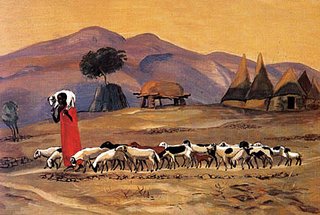
Image: Shepherd and her sheep.

Weak Enough To Be Helped?

In the Highlands of Scotland sheep often wander off into places they can’t get out off. They jump down onto ledges 10 or 12 feet below to enjoy the grass which is lush and sweet. However, down on the ledges they can’t get up easily, especially when they have a belly full of grass! They may be there for days until they have eaten all the grass.

The shepherd hears them bleating in distress but the shepherd does not go and get them immediately. Shepherds have learned that if they go down there when the sheep first strays, the sheep will often be so foolish and skittery that they will jump right over the precipice and be killed.

The shepherds wait until the sheep are so weak that that cannot stand. Then they will go down, put a rope around them and pull the sheep to safety.

Source: From one of Gordon Macdonald's fine books.

Image: Baaaaaa!!!

Facing Our Wolves

Some time back in America a bounty of $5,000 was offered for each wolf captured alive. This challenge turned Sam and Jed into two hunters who were determined to make their fortune. These two, day and night, scoured the mountains and forests looking for their valuable prey.

One night they were exhausted and they fell asleep dreaming about their potential fortune.

Suddenly Sam awoke and he saw that the two of them were surrounded by about 50 wolves. The eyes of the wolves were flaming, their teeth were bared and they were snarling, ready to pounce.

At first, Sam thought this was the end. But then he thought differently and he nudged his friend and said, “Jed, wake up, we are rich!”

Image: Wolves

Saturday, April 29, 2006

Cockroach Communication

I wonder whether you heard about the man who was travelling on an international flight when at lunchtime he opened his prepackaged meal only to discover right on top of the salad an enormous cockroach.

When he got home he wrote an indignant letter to the director of the airline and a few days later a letter arrived from the director not by normal post but by special courier. He was all apologies. His letter read:

‘Dear Sir, this was very unusual but don't worry. I want to assure you that that particular plane has been completely fumigated. In fact all the seats and the upholstery have been stripped out. We have taken disciplinary action against the stewardess who served you that meal and she may even be fired.’

‘It's highly probable that this particular aeroplane will be taken out of service. I can assure you that it will never happen again. ..And I trust that you will continue to fly with us.’

Well, the man was terribly impressed by such a response but later he turned the letter over and he noticed something strange.

Quite by accident the letter he had written had stuck to the back of the director's letter. When he read his own letter he saw a note at the bottom which the director had scrawled for his secretary. It read,
‘Please reply with the regular cockroach letter.’

That's a fairly common trend these days isn't it?
Word processors are whiz at making letters appear personal.

When people pour out their problems it is so easy to reply with the stock answers.

But the pat answer, ‘cockroach letter syndrome’ fails to recognise the uniqueness of each person. The pastoral challenge is to be attentive to a person's individuality and to respond in appropriate ways.

Geoff Pound

Image: Cockroach

Tension In The Tank

In the United States cod fish are not only a favourite dish, they are big business. The tasty cod come from way up the north east but they are ordered on the tables all over the States. Meeting the public demand once posed a great problem for the fishermen.

First they froze the cod and shipped them elsewhere but the freezing took away a lot of the flavour. Then they experimented shipping them alive in great tanks of sea water, but that was worse. Not only was it more expensive, but the fish lost its flavour and in addition to these safe shallow tanks the fish became soft and mushy.

Finally someone solved the problem in a creative manner. The cod fish were placed in the tank of water along with their natural enemy the catfish. So from the time the fish left the east coast until it arrived in its western most destination those horrible catfish chased the cod all over the tank and you guessed it - when the cod arrived at the market and the meal table they were as fresh as when they were first caught.

Got any catfish swimming around in your tank? Maybe you live with one of them, or it is somebody at work whose irritating presence drives you to despair, or to your knees. Every community has a few catfish lurking around. We don’t always warm to them but they can keep all the others from getting soft and mushy.

You see, it is the difficulties and the discouragement, the tension in the tank that helps develop our character.

Source: From one of Chuck Swindoll’s books.

Image: One member of the catfish clan.

Friday, April 28, 2006

Four Legged Guide

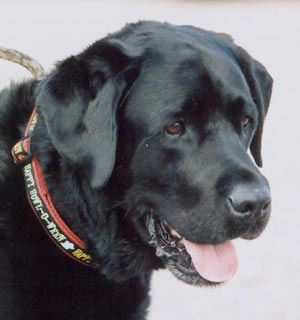
There is one member of the congregation at the Upper Hutt Baptist Church (NZ) that I will never forget. Her name was Relda. She was there most Sunday mornings with her friend Alison, sitting in their usual place. When the congregation stood to sing she would stand and then sit again at the appointed time. As I preached my sermon, though, she would yawn and regularly nod off to sleep (she wasn’t the only one!).

Relda was a black Labrador dog. Alison was blind and she depended on her canine friend to guide her wherever she went.

One memorable night during my student pastorate, Alison and Relda were present at a home group meeting. At supper time the rain was pelting down outside and the host asked me if I would take Alison home. I agreed and then asked him quietly to tell me where Alison lived. “I’ll show you the way”, said a voice from the other side of the room. It was Alison.

With Relda perched on the backseat of my car and the windscreen wipers working overtime, Alison guided me the two mile distance to her home. She directed me as well as anyone could. She knew the street names and landmarks perfectly. As I turned into the last street she said that she lived “up a long right of way, half way up the hill on the left hand side”. When she told me to stop I could see no letter box. There were no street lights, only the light of the house in the distance.

I stopped the car and said, “I’ll come with you to the door”. “No, there is no need”, she insisted as they scrambled out of the car. “I’ll be fine!” Then Alison said, “So long as Relda knows the way, I’ll be right.”

The door slammed and Alison’s words echoed in my mind as I sat stunned in the inky silence.

Geoff Pound

Image: Black lab

Thursday, April 27, 2006

Dachshund Marsala

If you didn't read yesterday's (26/4/06) blog posting, 'Testing a New Communication Theory' it might make good sense to read that posting first.

If you did, then you will know that today's posting is the first in a series of stories which have an animal theme for we are testing out a new communication theory about the power of animal stories!

When my mother was speaking at her Baptist church’s fiftieth anniversary she told the audience this secret. Years earlier she had been asked to provide the lunch for the Women’s Group. She cooked up a large pot of curry and sat it lidless on the car floor, before the front passenger seat. Bino, our miniature dachshund, was commanded to stay on the ledge behind the back seat.

When the car was approaching the venue the dog jumped onto the front seat. When Mum slammed on the anchors Bino went forward and ended up in the pot of curry. In good Baptist fashion it was a total immersion. The dog emerged paddling in bits of spicy chicken and vegetables.

Mum dried Bino off with a towel, smoothed over the curry and proceeded to serve the lunch as if nothing untoward had happened.

She said in her speech that she was relieved to see at the anniversary that so many of the women were still alive years after devouring her hot dog curry. She concluded, “You will be relieved to know that I am not in charge of preparing today’s lunch.”

Geoff Pound

Image: Drenched Dachshund

Wednesday, April 26, 2006

Testing a New Communication Theory

I’ve got an exciting new theory! This is it:

Communicators will get their message across more effectively to their hearers when they regularly include stories about animals, preferably their pets.

I need your help (if you’re a communicator) to test this theory but let me elaborate first.

I first thought about this idea when I reflected several years after doing my first course in Early Church History. One of the most memorable things I retained after all the years was the insightful question: "Why is the Athanasian Creed like a tiger?" Answer: "Its got great big clauses at the end of its pauses." This has provided great illumination for me down through the decades.

News broadcasters have known this for years. How often does the News coverage conclude with a story of some snuggly puppy dogs or a newly born giraffe at the local zoo?

Sometimes the angle is the irresistible cute story to hook us while we’re making coffee during the ad break. Another category is the cat up the lamp post that is saved by two crews from the local fire brigade. Oh, how we love a rescue story.

My theory has been bolstered since reading today's article (26 April 2006) in the Business Section of the Melbourne Age, entitled 'Draining Cats and Dogs'.

Writer Denise Cullen, reports on the high amounts being spent on pets in Australia:

“When Cleo, a miniature poodle, sashays into the pet grooming salon every two months, owner Melanie Ward barely blinks at the $65 bill.”

“You get so much joy out of having pets around,” explains Ward, 27, of Condell Park. “I would never want to live without them , regardless of their cost,” she added.

Remembering it is a business article Cullen then puts in the bite:
“It’s a view shared by many Australians who, according to 2004 research from the Australian Institute, spend more on their pets each year….about $2.2 billion…than they provide in aid to poorer countries.” Ooooch!

The report goes on to detail the high cost of maintaining ordinary mutts; it's not just the price of manicuring pedigree pooches.

I can sniff something here, can’t you? If communicators want to speak clearly and dearly to the hearts of their hearers then they need to weave in a telling animal story.

This doesn’t mean preaching a series on Noah and his floating zoo or telling Jonah’s whale of a story or expounding that final verse in his book that makes animal lovers drool. We don’t have to stage our sermon or speech in the open-air when we speak on the topic ‘Look at the Birds of the air.’ But it does mean an equine reference here, a feline quote there and a shaggy dog story to pat the speech home.

I need your help. Would you put this theory to the test by including in the next few weeks some dramatic stories of animals in your own speeches and sermons?

Since I started this Stories for Speakers blog site the readers have increased exponentially. Over the next few days (or until I run out!), I am going to drop into my blog some animal stories and I will be on the look out to see if the blog hits increase dramatically.

Do let me know in a comment, what you are discovering as you help me trial this exciting new theory.

Geoff Pound

Source: ‘Draining Cats and Dogs’, The Age, 26/4/06. Read this article at:
http://www.theage.com.au/news/money/its-draining-cats-and-dogs/2006/04/24/1145861284634.html

Image: Cuddly kittens (thanks to the Age).
A Faith To Sing About

My friend and former colleague, Simon Holt, in his Simply Simon blogsite has posted this wonderful reflection and song (which from memory goes to the tune Finlandia):

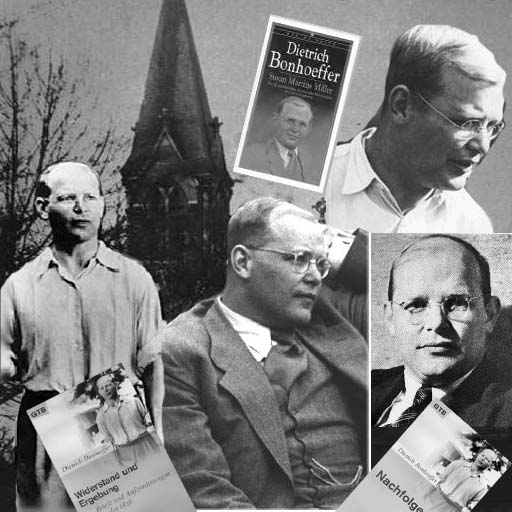
Dietrich Bonhoeffer (1906 – 1945), theologian and founder of the Confessing Church's underground seminary in Germany, became a leading spokesman for the Protestant resistance to the Nazi regime. His active involvement in a plan to overthrow Hitler saw him arrested, imprisoned and, ultimately, condemned to death. At just 39 years of age, one of the most promising and challenging voices in theology was silenced. Yet the influence of his life and writing upon the Christian church has been extraordinary.

Bonhoeffer wrote the following hymn in the concentration camp shortly before his death. We sang these words in chapel just yesterday, an experience I found quite moving.

By gracious powers so wonderfully sheltered,
and confidently waiting come what may,
we know that God is with us night and morning,
and never fails to greet us each new day.

Yet is this heart by its old foe tormented,
still evil days bring burdens hard to bear;
Oh, give our frightened souls the sure salvation
for which, O Lord, you taught us to prepare.

And when this cup you give is filled to brimming
with bitter suffering, hard to understand,
we take it thankfully and without trembling,
out of so good and so beloved a hand.

Yet when again in this same world you give us
the joy we had, the brightness of your Sun,
we shall remember all the days we lived through,
and our whole life shall then be yours alone.


Source: Simon Holt in his blog site, Simply Simon
http://simoncareyholt.typepad.com/

Image: A Dietrich Bonhoeffer montage.

Open to Wonder

When the great cellist Pablo Casals was 93, he wrote:

"For the past eighty years I have started each day in the same manner. I go to the piano and I play two preludes and fugues of Bach. It is a sort of "benediction" on the house. But that is not its only meaning. It is a rediscovery of the world in which I have the joy of being a part. It fills me with awareness of the wonder of life; with a feeling of the incredible marvel of being a human. "

For the good of our souls, let us take time out to wonder.

For as the poet reminds us:
"A poor life this, if full of care we have not time to stand and stare."

Source: Told by Barrie Hibbert in his address at the Melbourne College of Divinity Annual Conferral, 27 April, 2001.

Image: Pablo Casals.

Sunrise of Wonder

One of the most inspiring books I have read in recent years was written by Michael Mayne when he was Dean of Westminster Abbey. It is written as a series of letters to the author's grandchildren, sharing with them all that has inspired their grandfather in literature, music and art. The book's title is a phrase taken from a quotation from G. K. Chesterton:

"At the back of our brains, so to speak, there is a forgotten blaze or burst of astonishment at our own existence. The object of the artistic and spiritual life is to dig, for this sunrise of wonder."

I commend the book, "This Sunrise of Wonder".

Source: Words of Barrie Hibbert, guest speaker at the Melbourne College of Divinity Conferral Ceremony, 27 April 2001. Thanks Barrie (GP).

Image: Sunrise over lake.

Tuesday, April 25, 2006

My Topic Today Is....

A speaker in his introduction said, “My topic today is ‘Ignorance and Apathy’.

A child leaned over to his Dad and said, “What’s ignorance and apathy?’

The father replied, “I don’t know and I don’t care!”


Source: Stuart Briscoe, Everyday Discipleship, p94.

Image: Preacher

This Is a Better World

Do you remember the conversation between Charlie Brown and Linus?

"I think the world is a much better place today... better than it was say five years ago."

"How can you say that? Don't you ever read the paper? Don't you ever listen to the radio? How can you stand there and tell me that this is a better world?"

"I'm in it now."

Whatever our limitations, whatever our sense of failure, whatever our feelings of inadequacy, you and I are needed in this sad and broken world. What's right with the world? We're in it!

That may sound arrogant but it is not. We are here to make a difference, to cope with the ups and downs, to challenge the status quo, to bring some love to our needy world. When we do our bit the world is a better place.

Source: From the cartoonist, Charles Schultz. Told in a sermon by Graham Brogden in Palmerston North, NZ, 11 January 1989.

Image: Charlie Brown and Linus

So, What Do You Do?

Peggy Campolo, in her early days as a mother, was sometimes annoyed at the fact that she had chosen to stay home and look after the kids while her husband, well known Tony Campolo, went out to work as a sociologist and gallavanted around the world as a lecturer and public speaker.

Peggy found it particularly hard when she was at parties and people would say, "What do you do?" She would usually reply, "I'm a house manager." When she gave this reply she got the feeling that people thought that wasn't significant and their whole body language reinforced this message.

So Peggy devised another way of answering the question so when somebody asked, “What do you do” she would say:

"We are socialising two homo sapiens into the dominant value of the Judaeo-Christian heritage in order that they may be instruments for the transformation of the social order according to the eschatological utopia planned by God from the beginning of creation."

Then she would say, "And what do you do?" and they would often say, "I'm just a lawyer!"

Source: This story arose in a lunchtime conversation with Arbutus Sider when Ron Sider was lecturing at Whitley College, Melbourne in 1994.

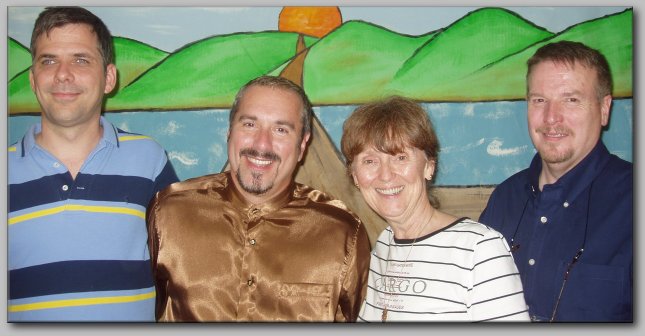
Image: Peggy at a conference, pictured with three pastors.

Is That What You Mean?

Moving around the world it is intriguing and often humorous to observe some of the signs.

For instance a sign inside a hotel in Chiang Mai, Thailand said: ‘Please do not bring solicitors into your room.’

A brochure in an Italian hotel boasted its location when saying: ‘This hotel is renowned for its peace and solitude, in fact, crowds from all over the world flock here to enjoy it solitude.’

A sign in a hotel lobby in Bucharest said, ‘This lift is being fixed for the next day. During that time we regret that you will be unbearable.’

A Parisian hotel had a sign which read, ‘Please leave your values at the front desk.’

In a hotel in Athens a sign said, ‘Visitors are expected to complain at the office between the hours of 9 and 11am daily.’

In the lobby of a Moscow hotel across the road from a Russian orthodox monastery a sign read, ‘You are welcome to visit the cemetery where Russian and Soviet composers are buried daily, except Thursday.’

Outside a dry cleaners in Bangkok a sign said, ‘Drop your trousers here for the best results.’

An ad for a tourist agency in Czechoslovakia said: ‘Take one of our horse-driven city tours. We guarantee no miscarriages.’

A sign in a ticket office in Copenhagen said, ‘We take your bags and send them in all directions.’

On the door of a Moscow Hotel was this sign, “If this is your first visit to the USSR, you are welcome to it.’

A sign outside a doctor’s surgery in Rome said, “Specialist in women and other diseases.’

A sign outside a hotel in Acapulco said, “The Manager has personally passed all the water served here.’

Image: Space available in the dead centre of the town. I note there are numerous web sites with competitions devoted to zany signs (GP).

Giving The Right Message


A couple getting ready to move into their new house discovered a beautiful floral bouquet on their doorstep. They looked at it and reflected on this wonderful gesture.

They were somewhat puzzled, however, when they noticed that the accompanying card bore the words: ‘Rest in Peace’.

They thought this was a mistake so they took it to the florists who apologised profusely.

Then the florist said, "We understand your concern but think of the reaction when the bereaved family get their flowers with these words on the card:
"Good Luck for wherever you're going!"

Source: From a sermon by Robert Schuller, Hour of Power, circa 1998.

Image: RIP

Willingness to Fail

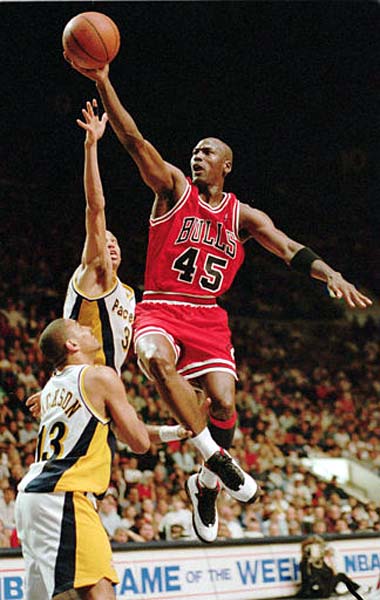
Often hailed as the greatest basketball player of all time, the statistical summary does not do him justice.

Michael Jordan, of the Chicago Bulls and the US Olympic teams, was a staggering athlete with a unique combination of grace, skill, power, artistry, improvisationand competitive hunger.

"Twenty six times," he said, "I have been entrusted to take the game and missed."

"I failed over and over again in my life."

"That is why I succeed."

Source: From an advertisement in which Michael Jordan stars.

Image: Michael Jordan

Monday, April 24, 2006

Canine Sense

One day the entire North American sales force from a dog food company
was gathered for their National Sales Convention at Miami Beach.

In the auditorium the marketing director was giving a performance that any preacher would have been proud of. Using the old pattern of call and response, he was working up the spirits of his sales team:
"Who's got the greatest dog food in North America?"
"We have!"

"And who's got the greatest advertising campaigns?"
"We have!"

"Who's got the most attractive packages?"
"We have!"

"Who's got the greatest distribution?"
"We have!"

"Okay! So why aren't we selling more of the product?"

One bold voice from the congregation said:
"Because the damned dogs don't like it!"

Source: John Gurney in The World's Best Salesman Jokes

Image: A couple of satisfied consumers!

Knowing Where You Are Going

Albert Einstein was on a train coming to New York City but couldn't find his ticket.

As the brilliant scientist frantically searched for his ticket, the train's conductor recognized him and assured Einstein it would not be necessary for him to find his ticket. Continuing to search, however, Einstein told the conductor, 'This is not an issue of trust, but of direction. Without that ticket, I have no idea where I am going.'

Source: Told by Billy Graham, Dec. 14 1999, in an address to world ambassadors, reported by Baptist Press, 12/20/99

Graham asked his audience if they were like Einstein, not knowing where they are going. He concluded by asking, "In the future, when you hear my name, would you give thought to your own final destination?"

Yes and No

I wonder if you heard of that person who had quite a reputation as an outstanding marriage counselor?

A trainee had the opportunity to sit in with the experienced counselor and the first day, after observing his counseling technique he was quite disappointed.

He said, "I am dumbfounded!"
"When Mrs. Baker came to you this morning complaining about her husband, you listened. When she finished, you said to her 'I agree with you, Mrs Baker, your husband is impossible and you are doing everything expected of a wife.'"

But this afternoon, Mr Baker came to see you and he complained of his wife. You listened and said, 'Mr Baker, you are right. You are married to an impossible woman. You are doing everything expected of a husband."

"That's ridiculous," complained the trainee to the seasoned counselor.
"You told them both they were doing fine and that their spouse was to blame.
Either the husband or the wife has to be doing something wrong.
They both cannot be totally right and both totally wrong!"

The counselor thought about the accusation and then he said,
"You know. You are right. You are so right."

When we listen compassionately and open our minds up to the views of others we will see a little bit of truth in nearly every opinion. It may be a partial truth or a twisted truth but still a bit of truth.

People who remain open to others will often feel like the counselor caught between the Bakers.
Its frustrating but seeing both sides of an issue is a necessity.

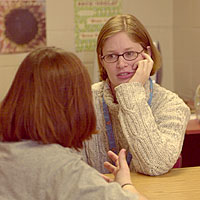
Image: A counseling relationship.

Saturday, April 22, 2006

Bearing a Faithful Witness

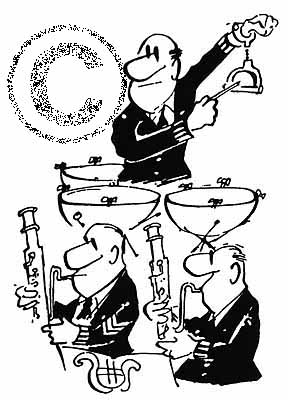
Dr George Buttrick told of an experience while attending the Boston Symphony Orchestra. He watched carefully the man with the triangle who was required by the music to sound only one note.

Minutes before that note he stood poised and ready to strike the triangle with his hammer. When the note was sounded it was hardly noticed by the audience but it certainly was noticed by the conductor.

The musician could have brought attention to his own importance. He might have struck the triangle too forcefully; he could have ‘come in’ too early or too late; he could have taken the bow at the end of the performance rather than the conductor.

He did none of these because his purpose was to bear witness and draw attention to the music and serve the conductor, not himself.

Source: Told by Dr John Claypool in a sermon entitled ‘Quo Vadis’, 4/2/1962.

Image: Triangle player seeking some prominence.

Lunar Communion

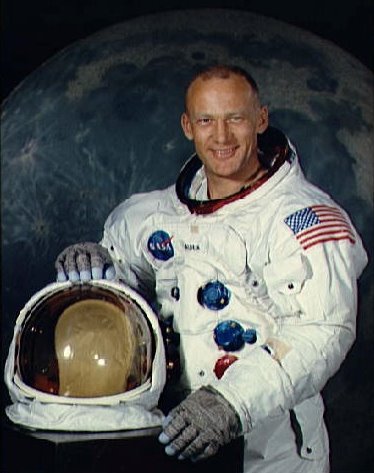
In writing about their arrival on the moon in Apollo 11, the lunar module, Buzz Aldrin said: “We were supposed to try to sleep for four hours before exploring the surface. But whoever signed off on that plan didn’t know much psychology. We’d just landed on the moon and there was a lot of adrenalin zinging through our bodies.”

“I had one ceremony I’d planned. My pastor at the church I attended in Houston had given me a tiny communion kit, complete with a miniature silver chalice and a wine vial about the size of my little fingertip. I asked ‘every person listening in, whoever and wherever they may be to pause for a moment and contemplate the events of the past few hours and give thanks in his or her own way.’”

“The clear plastic shelf in front of our DSKY became the altar. I read silently from the communion service, ‘I am the Vine and you are the branches’ as I poured the wine into the chalice. The wine looked like syrup as it swirled around the sides of the cup in the light gravity before it finally settled at the bottom.”

Eagle’s metal body creaked faintly. I ate the tiny host and swallowed the wine. I gave thanks for the intelligence and spirit that had brought two young pilots to the Sea of Tranquility.”

Source: Buzz Aldrin and Malcolm McConnell, Men from Earth, p170.

Image: Buzz Aldrin

Friday, April 21, 2006

What Are Your Hopes?

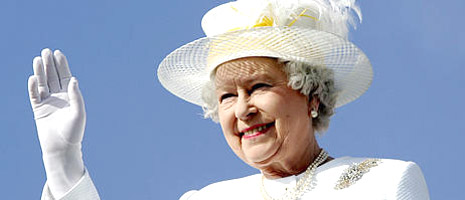
During this period when Queen Elizabeth has been celebrating her eightieth birthday she was asked, "What are you hoping for? What are your birthday wishes?"

The Queen replied: "A nice sunny day."

Her answer reminded me of a similar question asked once of political leaders.

The British Ambassador in Washington was asked by a television reporter what he would like for Christmas that year. Very modestly he declined to say but when pressed he eventually said he would be happy with a small box of crystallised fruit.

Months later on Christmas Eve the program appeared on television. The French Ambassador when asked what he would like for Christmas said, “I would like to see peace in the world with new agreements between the super powers.”

The German Ambassador said, “I want to see a new upturn in international trade and injustice rooted out among peoples”.

The British Ambassador said, “I would like a small box of crystallised fruit”.

What are your hopes?

Geoff Pound

Image: Queen Elizabeth in her eightieth year.

Exit and an Entrance

Reuel Howe was once visiting a very old friend who said to him,

“You know Reuel, I am amazed at how all this is working out. I always wondered what it would be like to die but lo and behold it is not all that unusual. Death has turned out to be an old acquaintance in a different garb.”

He said, “For years now I have undergone experiences like this. From my earliest days I had to learn to let go of some things I had in order to get some of the things I did not have."

"This is what I did the day I started school or left home to go to work, or launched out on a new career. It turns out that I have died a thousand deaths over the years and in all of this I have learnt something – 'every exit is also an entrance'. You never leave one place without being given another. There is always new life on the other side of the door and this is my faith as far as death is concerned. I have walked this way before. Death is an exit to be sure, but it is also an entrance.”

Source: Quoted in John Claypool's fine book, 'Stages' in the chapter on senior adulthood.

Image: Exit or Entrance?

Who is Reuel Howe? Listen to his own explanation given in a lecture:

"I remember years ago listening to a speaker named Reuel Howe. He spoke of being on an airplane and his seatmate asked him, "Who are you?"
Reuel said, "I suppose I could tell him I was an author, but if he hadn't read my books, I would be disappointed at my lack of fame. "

"Or, I could tell him I was a public speaker, even a preacher, but if he didn't subscribe to my way of thinking and theology, we would just end up having some sort of argument."

"So, he turned to the fellow and said, "I guess you could say I'm a pilgrim."
"You mean like one of those in the early settler days who met the Indians at Thanksgiving?"
"No," said Howe, "I'm a pilgrim on a journey."
"Where are you going?" asked the fellow.
Howe said, "I'm a pilgrim on a journey from Birth to Life." I like that. I guess that's a little how I look at this. Is that our journey together? A journey from Birth to Life. Yes, I guess I like that."

Told by Rev Craig Ellingboe on his blogsite which is at:
http://northfieldmba.typepad.com/craigellingboe/
Thanks Craig!