Thursday, January 25, 2007

Responding to Hate Mail

The American Congregationalist pastor, Henry Ward Beecher, once received a letter containing the single word, ‘Fool’.

Beecher told his congregation about it but not to rouse their ire or gain their sympathy. He went on to add, “I have known many an instance of a person writing a letter and forgetting to write their name but this is the only instance I have ever known of a person signing their name and forgetting to write the letter.”

Source: Robert J McCracken, Questions People Ask, New York: Harper & Row, 148.

Image: Henry Ward Beecher

Wednesday, January 24, 2007

Requiem for Darfur

Last Monday night a who's who of classical musicians combined with aspiring musos to play Verdi's Requiem at Carnegie Hall and to raise money for victims of the conflict in Darfur.

To read this moving story read:


Anthony Tommasini, 'Making Music Speak for those without a Voice', 24 January, New York Times.


Image: The picture that formed the backdrop at the performance.

It Pays To Get Your Facts Right

When introducing a guest speaker it pays to do your homework well.


The chairperson of a local Chamber of Commerce had the task of introducing the guest speaker at the organization’s annual dinner.

He began, “The man who I am about to introduce is someone I know you’ll enjoy listening to. He is the most gifted businessman in the country. He has made one hundred million dollars in California oil.”

The speaker approached the podium but he was looking slightly embarrassed. He said, “Thank you for your kind introduction, Mr. Chairman. However, the facts need some clarification. It wasn’t oil; it was coal. It wasn’t California; it was Pennsylvania. It wasn’t one hundred million; it was one hundred thousand. It wasn’t me; it was my brother. And he didn’t make it; he lost it.”

Source: John Maxwell, Recognize the Importance of Strategic Thinking, 128-129.


Image: After-dinner speaker

Tuesday, January 23, 2007

The Three Mile an Hour Environmentalist

After an oil spill in 1972 in the San Francisco Bay, John Francis gave up his car and other oil hungry machines and began walking everywhere.

A year later Francis stopped talking. He intended his silence to be for one day 'because I talked too much', but his 'word fast' went on for the next seventeen years.


After earning several degrees, John Francis has now become an environmental consultant and he is still reflecting on the lessons learned through his self-imposed silence.


For more on this fascinating story read:


Image: John Francis

Take a Look at Ourselves

The latest edition of the New York Review of Books contains the translated script of a compelling speech by David Grossman. Speaking at the annual memorial ceremony for Yitzhak Rabin he calls on the Israeli PM, leadership and all thinking people to be 'looking at ourselves'.

Image: David Grossman before the picture of Rabin.

Monday, January 22, 2007

Udderly Disgusting

Marketers have gone crazy in their quest to sell any space with their customer’s advertisements.

I am not one to hit the television mute button during ad breaks as I sometimes find the commercials to be more entertaining and skilful than the programs. But when supermarkets stamp the eggs with the names of upcoming TV programs, subway turnstiles bear messages from an insurance company and beds in doctor’s surgeries are covered with the brand of painkillers it is time to protest against the sensory overkill.[1] When driving along a freeway lined with gigantic, electronic billboards we are not free to close our eyes or hit the mute button.

Branding advertisements onto the backs of cows (see photo) is disgusting and so unpastural. When the church coffers are low it is tempting to sell the space on a church wall or steeple to the advertisers.[2] But isn’t any space sacred any more?

Oversupply, oversizing and inappropriate positioning of advertisements is visual pollution. It is as hazardous to our health as passive smoking is to our lungs or high-decibel noise is to our hearing.

Geoff Pound

Image: A new spin on cattle branding.

Thrill of the Chaste

An interesting sexual journey is told by Dawn Eden in a recent British Times article entitled:

Casual Sex is a con: Women just aren't like men.


Image: Cover of Dawn Eden's new book.

Sunday, January 21, 2007

Faith, Creativity and Caffeine

Millions of American Jews read the order of service for their Seder, or Passover meal, from a booklet produced by Maxwell House Coffee. For more than seventy years the coffee company has produced the booklet, called the Hagadah, and during those years it has distributed more than 20 million copies.

How did Maxwell’s Coffee House come to supply Passover booklets? It was the result of some innovative thinking.

Eighty years ago, marketing man Joseph Jacobs advised that the company could sell coffee during Passover if the product was certified kosher by a rabbi. Then Jacobs suggested that if they gave away Hagadah booklets they would increase sales. They have been producing the booklets and selling coffee during Passover ever since.

It is amazing how hurdles can be overcome when we allow our creativity and faith to percolate.

Sources:
John Maxwell, Release the Power of Strategic Thinking.

Image: Hagadah Booklet with the compliments of Maxwell Coffee House (for further details see the following link):
From Haven to Home: 350 years of Jewish Life in America

Saturday, January 20, 2007

Dreaming and Living

A study was once carried out of concentration camp survivors in order to ascertain the common characteristics of those who did not succumb to disease and starvation. One survivor wrote extensively about what kept him going.

Victor Frankl was a Viennese psychiatrist before he was put into a concentration camp by the Nazi regime. Upon his release he said in a speech, “Why am I here today? What kept me alive was you. Others gave up hope. I dreamed. I dreamed that somehow I would be here, telling you how I, Victor Frankl, had survived the Nazi concentration camps. I’ve never been here before. I’ve never seen any of you before. But in my dreams I have stood before you and said these words a thousand times.”

Geoff Pound

Source: Victor Frankl, Man's Search for Meaning.

Image: Victor Frankl

Friday, January 19, 2007

Luther and that Hat

The teacher who gave the great reformer Martin Luther his Christian instruction, always took off his hat when he came before the class of little boys. When asked why he did this the teacher answered without hesitation, “Who knows who might be in this class? One of these boys could well change the whole world.” That expectant and respectful attitude was so richly rewarded.

Geoff Pound

Image: Martin Luther

Thursday, January 18, 2007

It's Not Over Until It is Over

In 1983, Henry Blofeld (affectionately known as 'Blowers') was a sports reporter for The Guardian and was covering the cricket game between Essex and Surrey at Chelmsford. After the first day was washed out, the game was meandering to a draw and Surrey came in to bat with an hour remaining on the second day. Blofeld had to leave the ground early, however, to go to a dinner party, so he filed his copy and left a note for the sub-editor (the bloke who checks and cuts the words and saves most reporters' bacon more often than they'd admit) saying "please insert how many runs Surrey scored and how many wickets they lost".

Come 10pm, around the time the port was being passed around at Blofeld's dinner, and the great man calls into the office to see if everything was ok. "How many runs did Surrey score?" Blofeld asked the sub. "Fourteen" was the response. "And how many wickets did they lose?" "Ten."


Of course, Blofeld had written his story from the point of view of the match heading for a draw, rather than one side being bowled out for the lowest total in history. Fortunately, the sub had taken it upon himself to rewrite the story (which still appeared under Blofeld's name).
What makes the story even more interesting is that apparently the sub was a young fellow by the name of Matthew Engel, now Editor of Wisden Cricketers' Almanack.

Source: http://timesonline.typepad.com/line_and_length/2006/11/thar_he_blows.html

Image: Henry Blofeld

Wednesday, January 17, 2007

Three Men in a Boat

Having recently returned from Kolkata where influenza was raging and Indonesia where they have just buried the country’s 79th victim of bird flu I decided to keep in touch with developments and subscribe to the email reports of the International Society of Infectious Diseases. After a few days of reports I am starting to question the wisdom of getting these mailings.

Here are the titles of the diseases in yesterday’s (16 January 2007) mailing:
Rift Valley Fever in Egypt
Botulism in Spain due to canned artichokes
Avian influenza: new cases in Indonesia, Vietnam, Hong Kong, Egypt, South Korea, Japan and Nigeria
Typhoid Fever update
Epidemic haemorraghic fever in China
Measle outbreak in Scotland
Salmonella from a meat slicer in the USA
Coccidiodomycosis in the USA
Norovirus in Russia
Undiagnosed fungal disease killing platypus in Australia
Undiagnosed deaths in Poland
Foot and mouth disease in Jordan

As I have looked at the headings and scanned the contents I have been feeling a little queasy! I have been reminded of the incident at the beginning of Jerome K Jerome’s Three Men in a Boat. It is an old book but it is still a funny read. Here is the opening to this classic:

THERE were four of us – George, and William Samuel Harris, and myself, and Montmorency. We were sitting in my room, smoking, and talking about how bad we were – bad from a medical point of view I mean, of course.

We were all feeling seedy, and we were getting quite nervous about it. Harris said he felt such extraordinary fits of giddiness come over him at times, that he hardly knew what he was doing; and then George said that HE had fits of giddiness too, and hardly knew what HE was doing. With me, it was my liver that was out of order. I knew it was my liver that was out of order, because I had just been reading a patent liver-pill circular, in which were detailed the various symptoms by which a man could tell when his liver was out of order. I had them all.

It is a most extraordinary thing, but I never read a patent medicine advertisement without being impelled to the conclusion that I am suffering from the particular disease therein dealt with in its most virulent form. The diagnosis seems in every case to correspond exactly with all the sensations that I have ever felt.

I remember going to the British Museum one day to read up the treatment for some slight ailment of which I had a touch – hay fever, I fancy it was. I got down the book, and read all I came to read; and then, in an unthinking moment, I idly turned the leaves, and began to indolently study diseases, generally. I forget which was the first distemper I plunged into – some fearful, devastating scourge, I know – and, before I had glanced half down the list of “premonitory symptoms,” it was borne in upon me that I had fairly got it.

I sat for awhile, frozen with horror; and then, in the listlessness of despair, I again turned over the pages. I came to typhoid fever – read the symptoms – discovered that I had typhoid fever, must have had it for months without knowing it – wondered what else I had got; turned up St. Vitus’s Dance – found, as I expected, that I had that too, – began to get interested in my case, and determined to sift it to the bottom, and so started alphabetically – read up ague, and learnt that I was sickening for it, and that the acute stage would commence in about another fortnight. Bright’s disease, I was relieved to find, I had only in a modified form, and, so far as that was concerned, I might live for years. Cholera I had, with severe complications; and diphtheria I seemed to have been born with. I plodded conscientiously through the twenty-six letters, and the only malady I could conclude I had not got was housemaid’s knee.

I felt rather hurt about this at first; it seemed somehow to be a sort of slight. Why hadn’t I got housemaid’s knee? Why this invidious reservation? After a while, however, less grasping feelings prevailed. I reflected that I had every other known malady in the pharmacology, and I grew less selfish, and determined to do without housemaid’s knee. Gout, in its most malignant stage, it would appear, had seized me without my being aware of it; and zymosis I had evidently been suffering with from boyhood. There were no more diseases after zymosis, so I concluded there was nothing else the matter with me.

I sat and pondered. I thought what an interesting case I must be from a medical point of view, what an acquisition I should be to a class! Students would have no need to “walk the hospitals,” if they had me. I was a hospital in myself. All they need do would be to walk round me, and, after that, take their diploma.

Then I wondered how long I had to live. I tried to examine myself. I felt my pulse. I could not at first feel any pulse at all. Then, all of a sudden, it seemed to start off. I pulled out my watch and timed it. I made it a hundred and forty-seven to the minute. I tried to feel my heart. I could not feel my heart. It had stopped beating. I have since been induced to come to the opinion that it must have been there all the time, and must have been beating, but I cannot account for it. I patted myself all over my front, from what I call my waist up to my head, and I went a bit round each side, and a little way up the back. But I could not feel or hear anything. I tried to look at my tongue. I stuck it out as far as ever it would go, and I shut one eye, and tried to examine it with the other. I could only see the tip, and the only thing that I could gain from that was to feel more certain than before that I had scarlet fever.

I had walked into that reading-room a happy, healthy man. I crawled out a decrepit wreck.”

I have cancelled my daily dose of reports on infectious diseases and have already noted an improvement in my health. It is amazing how an avalanche of bad news or a fellowship of negative people can affect us.

Geoff Pound

Source: Jerome K Jerome, Three Men in a Boat.

Image: Picture from Jerome’s book.

Memorizing Your Way to Freedom

The United Arab Emirates has come up with a novel way to reform its prison inmates. Since 2002 the Dubai authorities have offered to prisoners a reduction in their jail term if they can recite portions of the Quran. The well-defined incentives range from a three month deduction for memorizing three sections of the Quran to a twenty year deduction for reciting the entire book (which amounts to 6,346 verses or 80,000 words). Hundreds of prisoners have enrolled in this Inmates Memorization Program[1] and scores are benefiting from a reduction in their prison term.[2] Testimonies from these recipients indicate that the memorization of the Quran has brought joy, achievement and “a change of heart” as well as a release from prison conditions.[3]

The program is another initiative of Shaikh Mohammed Bin Rashid Al Maktoum who has transformed most sectors of Dubai. It is an extension of the International Holy Quran Award[4] which promotes the memorization of the Quran through its widely publicized annual contests complete with diplomas and attractive financial awards.

There is an extensive Islamic tradition of Quranic memorization stretching back to the Prophet Mohammed who was regarded as the first hafiz, a term given to a person who has memorized the entire text.

For many years Christians have encouraged the memorization of the Holy Bible (which consists of 31, 102 verses or 783, 137 words). The Navigators[5] has produced scripture verses on cards called the Topical Memory System and now a range of software is being made available to aid believers in the art of memorization. In earlier times and in cultures where literacy levels were low, memorization and recitation were primary ways of transmitting the faith. Many advocates today are promoting the memorization discipline to develop a holy life (‘I hide God’s word in my heart that I might not sin…’), as a guard against temptation (Christ’s example in his time of testing) and as a way of letting the truth seep down deep to shape one’s character (‘Let the word of God dwell in you richly’).

Memorization of famous speeches and Tennyson poems, let alone Holy Scripture, is not popular in this age that has labeled such practices as rote learning. However, the Jewish Scriptures proclaim the truth that “as a person thinks in their heart so are they.” This reminds us that what we fill our minds with and what we set our hearts upon (both good and bad), will inevitably produce a change in our behavior.

Geoff Pound

Image: Prison inmates being presented with diplomas for memorizing the Quran.

[1] The Holy Quran Memorisation Program for Inmates
[2] Alia al Theeb, ‘Jail Inmates to be Released after Memorising Quran’, Gulf News, 15 February 2006.
[3] Sanaa Maadad, ‘Freedom for Five for Memorizing Quran’, Khaleej Times, 17 October 2002.
[4] International Holy Quran Award
[5] Navigators

Tuesday, January 16, 2007

Becoming More Ourselves

Thomas Merton was a capable student with all sorts of opportunities before him but he shocked many when he exchanged it all for a life of prayer in a monastery in the hills of Kentucky. Business people speculated on what he might have become. They thought he now would turn out to be a silenced, suffering version of his former self, weighed down by the sacrifices and discipline of the monastic life.

After thirteen years, Mark van Doren visited him and when he reported back to Merton’s old friends he said, “He looked a little older but as we sat and talked I could see no important difference in him, and once I interrupted a reminiscence of his by laughing. “Tom,” I said, “you haven’t changed at all.” “Why should I? Here,” he said, “our duty is to be more ourselves, not less.”

Source: Max Lucado, Cure for the Common Life, 34-35.

Image: Thomas Merton.

Monday, January 15, 2007

A Whale of a Lesson

There is a great story in the New York Times about a woman who discovers that training her husband or children can be so easily learned from the way handlers train their whales.

Check out What Shamu Taught Me About a Happy Marriage.

Geoff Pound

Everybody Can Be Great

Development of the Dreamer
Martin Luther King Jnr., was born on this day (January 15) in 1929 at the family home in Auburn Avenue Atlanta, Georgia. He was the first son and second child born to Alberta and Rev. Martin Luther King Snr.

Growing up in Georgia, Martin suffered those experiences of discrimination that demoralize and outrage human dignity. He recalls the curtains that were used on the dining cars of trains to separate white from black. "I was very young when I had my first experience in sitting behind the curtain," he said. "I felt as if a curtain had come down across my whole life. The insult of it I will never forget."

I remember riding with him [my father] when he accidentally drove past a stop sign. A policeman pulled up to the car and said, "All right, boy, pull over and let me see your license."

My father replied indignantly, "I'm no boy." Then pointing to me, "This is a boy. I'm a man and until you call me one, I will not listen to you." The policeman was so shocked that he wrote the ticket up nervously and left the scene as quickly as possible.
With this heritage, it is not surprising that I had... learned to abhor segregation, considering it both rationally inexplicable and morally unjustifiable.

On another occasion, he and his school teacher were riding a bus from Macon to Atlanta when the driver ordered them to give up their seats to white passengers. "When we didn't move right away, the driver started cursing us out and calling us black sons of bitches. I decided not to move at all, but my teacher pointed out that we must obey the law. So we got up and stood in the aisle the whole 90 miles to Atlanta. It was a night I'll never forget. I don't think I have ever been so deeply angry in my life."

It so often that a dream comes to us through pain, through some event, some situation we have a burden for. Yours might be a burden for young people, for street kids, for people who are wasting their lives away thru drugs, for people who can't secure jobs and are bored stiff. Do you have a real burden for some group of people? Do you find yourself weeping for people? Let God use that pain that it might be a catalyst for some dream that he wants you to possess.

Qualifications for Service
Martin Luther King had a university training but he was later to talk about the qualifications for serving God. Perhaps he had Rosa Parkes in mind when he said:

Everybody can be great. Because anybody can serve.
You don't have to have a college degree to serve.
You don't have to make your subject and your verb agree to serve.
You don't have to know about Plato and Aristotle to serve.
You don't have to know Einstein's theory of relativity to serve.
You don't have to know the second theory of thermodynamics in physics to serve.
You only need a heart full of grace. A soul generated by love.

Within hours, the black Americans were embarked upon a bus boycott that almost ruined the bus company. Martin Luther King Jnr., was elected the President of the Boycott committee. Montgomery was one of the first great battles won by the blacks in the South and it all began when a woman refused to stand up.

Death of the Dreamer
The next morning (4 April 1968) Dr King was shot while standing on the balcony of the Lorraine Motel in Memphis. His funeral services were held on 9 April 1968 in Atlanta at the Ebenezer Baptist church and on the campus of Morehouse College with the President of the United States proclaiming a day of mourning.

The area where King was entombed is located on Freedom Plaza at the Martin Luther King Jr., Center for Nonviolent Social Change. On his grave are the words, "Free at last."

The door of the Lorraine Motel in Memphis has the inscription, "Martin Luther King Jnr., 1929-1968 followed with Ralph Abernathy's funeral text from Genesis, "Here Comes the Dreamer let us Kill Him."

Today we remember the birth of Martin Luther King Jnr., the dreamer. We also recognize that while people can kill the dreamer they cannot kill God's dream.

Geoff Pound

Image: Martin Luther King Jnr.

Thursday, December 07, 2006

The Leadership Meeting

The other day I was talking with a friend who was sounding off about the lack of team work that he was experiencing and the 'every person for themselves' culture. I asked him how often they have a leadership team meeting at his company. "About every six to eight months," he said. with a sense of frustration.

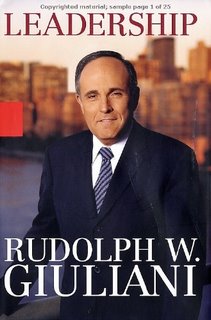
This conversation about the dsyfunctional work environment coincided with my reading of Rudolph Giuliani's superb book entitled Leadership. Here is his description and reflection on his team meetings when he was mayor of New York:

"Every morning, at exactly eight o'clock, I make my mother very happy. Throughout my childhood, she would lecture me on the virtues of finishing my schoolwork before I went outside to play. It used up a lot of daylight, which always annoyed me, but as with almost everything she taught me, she turned out to be right."

"That's why I've begun every single morning since 1981 with a meeting of my top staff. The importance of the "morning meeting" cannot be overstated. In all my time as mayor, I missed very few such meetings, and then only when another commitment absolutely prevented my attendance. I consider it the cornerstone to efficient func­tioning within any system, especially a complex one."

"When I became mayor, I realized that the job could overwhelm me. Without a system for processing the day's challenges, the sheer number of issues needing my attention could easily have dictated the agenda. The main purpose of the morning meeting was to get control of the day and prevent that from happening. We could accomplish a great deal during that first hour, in large part because the lines of communication were so clear. The people who needed to reach me-like the members of any large organization who need to convey information to the chief executive-knew that their concerns could be funneled in an orderly way through their representatives at the meeting; and I could ensure that my deputies and commissioners were working off the same page and could carry a coherent message back to their staffs."

"Paul Crotty, my first Corporation Counsel, knew Mayor Wagner, Mayor Lindsay, and Mayor Beanie, and had worked for Mayor Koch before working in my administration. According to Paul, ours was the only administration that got all the commissioners to speak with one voice. He attributed that to the eight o'clock meeting. He once recounted how, in the Koch administration, a number of commissioners thought that they were empowered to make their own policy statements. After the budget was adopted, certain commissioners would go to the media during the City Council review process in an attempt to raise their department's budget, saying, "Well, if you give me some more money I can do such and such ..." In my administration, commissioners did their bargaining with the Office of Management and Budget. They could always appeal to me, but I wanted disputes settled within the family, not in the press."

"Early in my first term, some staff would try to skirt the scrutiny of other members of the administration by approaching me in private. It was one thing to have your initiative shot down by the mayor, quite another to have your peers suggesting a reason why a pet idea might not work, or a better way to go about it. Those suggestions and debunkings were often best for the city, though, and thus worth hearing. I insisted that all such plans be brought up at the morning meeting. More often than not, the others there had valuable information to contribute and could enhance the plan's chances of gaining my approval."

"The only exception to the rule about skirting the group and bringing matters directly to my attention was Denny Young, officially "Counsel to the Mayor." At every morning meeting, when his turn round the table arrived, Denny would intone the same comment, "I'll talk to you later." He performed a function different from anyone else at the table; rather than managing his own portfolio of agencies and advocating for budgets and projects, he had a single concern: protecting all of us."

"The idea was to get as much work as possible out of the way in the first hour of the day. As mayor-as with the head of any large organization-I had many people trying to reach me. I may have had thousands of employees and millions of constituents, but I had to communicate with them. Obviously, I couldn't do that directly. What I tried to do was to have at the meeting the staff through whom I could communicate to all of those people, or through whom they could communicate to me."

"Here's how the morning meeting worked. At eight o'clock, my top staff-between fifteen and twenty people-convened around a table, ready to discuss the events of the day before and to plan for the one ahead. For forty-five to ninety minutes, we proceeded clockwise around the table, each participant sharing any pertinent news regarding the departments or agencies they represented."

Source: Rudolph W Giuliani with Ken Kurso, Leadership, (London: Time Warner, 2002), 29-30.

Image: Book cover and photo of Giuliani.

Wednesday, December 06, 2006

From Bethlehem to Bedlam

In England at the commencement of the 15th century there was a priory where monks and nuns would take refuge and pray. They were part of the Order of the Star of Bethlehem, so the Christ child and the obedient faith of Mary became the focus of their tradition.

In time as they reflected on the gospel and the message of Christmas they realised not that it was too good to be true, but it was so good it had to be true and that it had to be shared with others.

Instead of remaining in the cloisters in the comfort of their communion with God, they recognised that God was calling them to open the doors and welcome in people who were in need.

In time this monastery took in lots of people especially those who were mentally sick and had nowhere to go. It became the Bethlehem Hospital in London, in fact the first psychiatric hospital in that city, although it was then called a lunatic asylum.

Over the years the word 'Bethlehem' became shortened. When people slurred their words 'Bethlehem' became 'bedlam.' And bedlam became the name for a mental asylum and it has become the name for a scene of wild confusion and uproar.

From Bethlehem to Bedlam! The Christmas story begins at Bethlehem where we worship and adore and bring our gifts to the Christ child.

From there we must open the doors to the bedlam of this world. Entering into the madness and disorder with peace and care.

Image: Bethlehem Hospital, Bromley, London.

Tuesday, December 05, 2006

Open to Suggestions

In Costa Coffee shops their sandwiches and panini always bear these lines:

CONTACT US:
If you have any comments or ideas about how we can make your visits to Costas more enjoyable we’d love to hear from you. Visit us at:
www.costas.co.uk

Let this thought percolate through your mind.

The willingness to be open to improvement is one of the signs of an organization on the move.

The desire to listen to the constructive criticism and creative contributions of any coffee drinker is one of the marks of an effective leader.

Geoff Pound

P.S. I am not receiving any money or free coffee to write this article!

Image: Costa's coffee ware.

Saturday, December 02, 2006

Calm Soul of all Things

The historian, Peter Ackroyd, in his ‘biography’ of London writes about the significance of parks, gardens and wide open spaces to people in a busy, noisy city:

The silence of the nineteenth-century city can induce an almost spiritual sense of transcendence.

Matthew Arnold wrote some lines in Kensington Gardens, where peace and silence prevailed over ‘men’s impious roar’ and the ‘city’s hum’:

Calm Soul of all things! Make it mine
To feel, amid the city’s jar
That there abides a peace of Thine,
Man did not make and cannot mar.

So the ‘soul of all things’ is to be recognized within this silence.

Source: Peter Ackroyd, London: The Biography (London: Chatto and Windus, 2000), 84

Image: Kensington Gardens.

Friday, December 01, 2006

Bridging the Ages

This article on bridging the generational gap is stimulating:

Depressing Old Folk’s Home
Six months before she died, my grandmother moved into an old people's home and I visited her there when I was in Britain. She was sitting in the living room with about fifteen other residents, mostly women, half of them asleep. The room was clean and warm, with flowers and pictures, and the care assistants were kind and cheerful. 'The Weakest Link' was on the television ('to keep their brains active' one of the assistants said), and the only other sound was snoring and embarrassing digestive noises. People only moved when they needed to be helped to the bathroom. It was depressing. Gran talked a lot about how much she missed seeing her grandchildren (my nieces aged 7 and 5), but I knew from my sister that they hated going to visit her there, and to be perfectly honest, I couldn't wait to get away myself.

Revolutionary Rest Home
So I was interested to read a newspaper article about a new concept in old people's homes in France. The idea is simple, but revolutionary - combining a residential home for the elderly with a crèche/nursery school in the same building. The children and the residents eat lunch together and share activities such as music, painting, gardening, and caring for the pets which the residents are encouraged to keep. In the afternoons, the residents enjoy reading or telling stories to the children, and if a child is feeling sad or tired, there is always a kind lap to sit on and a cuddle. There are trips out and birthday parties too.

Mutually Beneficial
The advantages are enormous for everyone concerned. The children are happy because they get a lot more individual attention, and respond well because someone has time for them. They also learn that old people are not 'different' or frightening in any way. And of course, they see illness and death and learn to accept them. The residents are happy because they feel useful and needed. They are more active and more interested in life when the children are around and they take more interest in their appearance too. And the staff are happy because they see an improvement in the physical and psychological health of the residents and have an army of assistants to help with the children.

Bridging Isolation
Nowadays there is less and less contact between the old the young. There are many reasons for this, including the breakdown of the extended family, working parents with no time to care for ageing relations, families that have moved away, and smaller flats with no room for grandparents. But the result is the same - increasing numbers of children without grandparents and old people who have no contact with children. And more old people who are lonely and feel useless, along with more and more families with young children who desperately need more support. It's a major problem in many societies.

Circle of Care
That's why intergenerational programmes, designed to bring the old and the young together, are growing in popularity all over the world, supported by UNESCO and other local and international organisations. There are examples of successful initiatives all over the world. Using young people to teach IT skills to older people is one obvious example. Using old people as volunteer assistants in schools is another, perhaps reading with children who need extra attention. There are schemes which involve older people visiting families who are having problems, maybe looking after the children for a while to give the tired mother a break. Or 'adopt a grandparent' schemes in which children write letters or visit a lonely old person in their area. There are even holiday companies that specialise in holidays for children and grandparents together. One successful scheme in London pairs young volunteers with old people who are losing their sight. The young people help with practical things such as writing letters, reading bank statements and helping with shopping, and the older people can pass on their knowledge and experience to their young visitors. For example, a retired judge may be paired with a teenager who wants to study law. Lasting friendships often develop.

Society Bonus
But it isn't only the individuals concerned who gain from intergenerational activities. The advantages to society are enormous too. If older people can understand and accept the youth of today, and vice versa, there will be less conflict in a community. In a world where the number of old people is increasing, we need as much understanding and tolerance as possible. Modern Western society has isolated people into age groups and now we need to rediscover what 'community' really means. And we can use the strengths of one generation to help another. Then perhaps getting old won't be such a depressing prospect after all.

Source: Anonymous writer but the article can be found at:
http://www.britishcouncil.org/learnenglish-central-magazine-old-age.htm

Image: 'bridging the ages'

Thursday, November 30, 2006

Hide and Seek

Beware of the new trends in home furnishing that have just been announced in the USA.

We have visited homes where the TV is hidden away in a cabinet (supposedly not to dominate the living room). According to today’s LA Times, now we can buy dishwashers and refrigerators with paneling so they appear like a kitchen cabinet. Then we can purchase for Christmas a microwave concealed in a drawer.

Move to the room to which Borat disappeared at the dinner party and you will discover why he returned with his doings in a plastic bag? Because he couldn’t find the ‘loo’! Toilets are being hidden because they are not considered to be aesthetic. As part of the new range you can purchase a ‘bench toilet’, with seat, cistern and pipes all camouflaged.

It is done in the name of minimalism, uncluttering and simplicity. That’s rubbish when you see the price list:

The Bench Toilet starts at $US 12,000 (the lavatory is extra) and the price ‘depends on the size’ (I wonder how much a three seater costs, each with a muffler and a Chanel 5 dispenser?).

The Microwave starts at $850.

The cat litter box disguised as a planter costs $200 (don’t leave your cat with the neighbours when you go on holiday).

Ceiling fans without visible blades start at $825.

And people are already ordering these appliances in disguise for Christmas!

What’s wrong with a fridge in the kitchen? It reminds us that we thirst! We get hungry.

I like to see a good chopping board on the bench with some knives. They remind me that we must cook.

I like a free standing dunny or two in the house with reverberating walls. I actually find the sound of a forceful flush to be a liberating experience. The tuneful filling up of the cistern, I find to be soothing.

All this reminds me that I am human.

Jeff Spurrier, the reporter writing about this unwelcome trend, suggests it is an example of ‘botoxing the house’. Removing the wrinkles to keep up the appearances.

Simplify by all means. Unclutter the house. But let’s not continue down this road of denying our basic and rich humanity.

Geoff Pound

Source: Jeff Spurrier, ‘Rabbit in a Hat, LA Times, 30 November, 2006.
http://www.latimes.com/features/home/la-hm-hidden30nov30,0,7986440,full.story


Image: A Sydney man waiting proudly to use this Australian architectural icon.

Wednesday, November 29, 2006

Is Might Right?

F W Boreham tells this story in one of his many books:

“I was in London in 1888, when the Parnell Commission became the centre of world-wide excitement. Lord Frederick Cavendish, the Secretary of State for Ireland, and Mr. Burke, the Under-Secretary, had been murdered by Fenians in Phoenix Park, Dublin. The London Times charged Mr. Parnell, the leader of the Irish Party in the House of Commons, with complicity in the crime; and, to prove it, published a photograph of a letter in Mr. Parnell's handwriting condoning and approving the murders. Mr. Parnell at once declared that the letter was a forgery, and the Parnell Commission—one of the longest and most sensational legal cases of all time—was set up. It ended dramatically.”

“The Times had bought the letter from a man named Pigott for about five thousand pounds. Pigott claimed to have purchased the letter in Paris. Everybody felt that the crucial moment would come when Pigott, in the witness-box, was subjected to the merciless cross-examination of Sir Charles Russell. The great day came. On Wednesday, February 20, 1889, it was known that, immediately after the luncheon adjournment, Pigott would face his ordeal.”

“To the astonishment of the Court, Sir Charles Russell simply handed Pigott—a squat, corpulent, frock-coated figure, obviously extremely nervous—a sheet of paper. `Mr. Pigott' he said, blandly and politely, `would you be good enough, with my Lords' permission, to write some words for me? Perhaps you will sit down in order to do so!' He then dictated several words—‘livelihood', `likelihood', 'proselytism', and so on. And finally, as if it were purely an afterthought; he added the word `hesitancy'. Then, amidst breathless silence, he took the sheet of paper from the witness. Everybody could see from his expression that Sir Charles Russell had got what he wanted, and some even heard Frank Lockwood, Russell's junior, who had glanced at the document, exclaim: `We've got him!' Pigott had spelt the last word 'hesitency'. The same word was misspelt in the same way in the letter in The Times! Pigott left the box—and blew his brains out. The case that had absorbed the attention of the world had reached its climax and conclusion in the substitution of an `e' for an `a'! It was a case of a single letter. Hesitancy: hesitency…..What does it matter? But see how much it reveals!

Might! Right! It is merely a case of a letter. But at this moment millions of people are hazarding their happiness, their homes, their wealth, their very lives to prove that the two words are not synonymous. Might is not right! And rather than bow down to the champions of Might, people who love Right will gladly die.

Source: F W Boreham, ‘Shibboleth’, A Late Lark Singing (London: The Epworth Press, 1945), 143-148.

Image: Sir Charles Russell.

Tuesday, November 28, 2006

Leadership that Empowers

Stymie or Stimulate
Unfortunately many leaders block and stymie the initiative of the people they serve yet the important challenge for leaders is to address this question: How can we leaders better empower our people to use their gifts and get on and make their unique contribution?

Scarcity in the Sahara
It happened in the Sahara Desert during the Second World War where there was a French battalion serving in a very remote area. Because of this food supplies were often scarce and at one stage their clothes were absolutely worn out. All radio requests for new supplies went unheeded until one day the Red Cross dropped from a plane a great big bag of new uniforms. The soldiers were delighted.

But when some of the officers untied the canvas bag they discovered that very few of the clothes had labels and those that did obviously weren’t the size they purported to be! The officers puzzled among themselves wondering how ever they would work out a system so that every soldier got clothes that would fit.

“Debrouillez-vous!”
But while they were nutting out this problem the crusty old French commander stood before the soldiers and simply bellowed out: “Debrouillez-vous!” Which roughly translated means “Sort it out.” “You sort it out!”

All at once there was a massive dive into this mountain of clothes. Here they were thrashing around, trying them on and sorting them out. But before too long all these soldiers were happily fitted out, clothed and in their right uniforms. It all worked out amazingly well except for one poor chap who ended up with two left boots!

Foolish or Gifted
Sometimes when we are appointed to leadership, we think that we are surrounded by fools! We are the experts and every else are idiots. They need us to organise them and sort everything out, to decide, to approve, to control.

The soldiers in the Sahara remind us that our people are not nincompoops and if as leaders we protect them, if we encourage them and empower them they can be trusted to tackle even those things that we as leaders thought were unsolvable.

Geoff Pound

Image: Sahara Scene

Monday, November 27, 2006

Kneel Where Believers Have Knelt

I visited St Paul’s Cathedral recently and at a service of worship under the great dome I thought of the following story and the truth that it contains.

A group of pilgrims were retracing the steps of some of the early Christians in England and in one Cathedral that was centuries old, the tour guide said to the party: "Come forward and kneel here at the communion rail. It's a great thing to kneel at the place where the saints of old have knelt."

Kneeling or sitting at a communion table is what can unite us with believers all around the world.
It is this table that joins us with believers who have run the race yet still cheer us on.
It is this table that takes us back to that upper room and the one who first extended the invitation to gather and dine at the table.

It is at this table that we can commune with the living Christ and truly experience the communion of the saints.

Geoff Pound

Image: