Thursday, December 07, 2006

The Leadership Meeting

The other day I was talking with a friend who was sounding off about the lack of team work that he was experiencing and the 'every person for themselves' culture. I asked him how often they have a leadership team meeting at his company. "About every six to eight months," he said. with a sense of frustration.

This conversation about the dsyfunctional work environment coincided with my reading of Rudolph Giuliani's superb book entitled Leadership. Here is his description and reflection on his team meetings when he was mayor of New York:

"Every morning, at exactly eight o'clock, I make my mother very happy. Throughout my childhood, she would lecture me on the virtues of finishing my schoolwork before I went outside to play. It used up a lot of daylight, which always annoyed me, but as with almost everything she taught me, she turned out to be right."

"That's why I've begun every single morning since 1981 with a meeting of my top staff. The importance of the "morning meeting" cannot be overstated. In all my time as mayor, I missed very few such meetings, and then only when another commitment absolutely prevented my attendance. I consider it the cornerstone to efficient func­tioning within any system, especially a complex one."

"When I became mayor, I realized that the job could overwhelm me. Without a system for processing the day's challenges, the sheer number of issues needing my attention could easily have dictated the agenda. The main purpose of the morning meeting was to get control of the day and prevent that from happening. We could accomplish a great deal during that first hour, in large part because the lines of communication were so clear. The people who needed to reach me-like the members of any large organization who need to convey information to the chief executive-knew that their concerns could be funneled in an orderly way through their representatives at the meeting; and I could ensure that my deputies and commissioners were working off the same page and could carry a coherent message back to their staffs."

"Paul Crotty, my first Corporation Counsel, knew Mayor Wagner, Mayor Lindsay, and Mayor Beanie, and had worked for Mayor Koch before working in my administration. According to Paul, ours was the only administration that got all the commissioners to speak with one voice. He attributed that to the eight o'clock meeting. He once recounted how, in the Koch administration, a number of commissioners thought that they were empowered to make their own policy statements. After the budget was adopted, certain commissioners would go to the media during the City Council review process in an attempt to raise their department's budget, saying, "Well, if you give me some more money I can do such and such ..." In my administration, commissioners did their bargaining with the Office of Management and Budget. They could always appeal to me, but I wanted disputes settled within the family, not in the press."

"Early in my first term, some staff would try to skirt the scrutiny of other members of the administration by approaching me in private. It was one thing to have your initiative shot down by the mayor, quite another to have your peers suggesting a reason why a pet idea might not work, or a better way to go about it. Those suggestions and debunkings were often best for the city, though, and thus worth hearing. I insisted that all such plans be brought up at the morning meeting. More often than not, the others there had valuable information to contribute and could enhance the plan's chances of gaining my approval."

"The only exception to the rule about skirting the group and bringing matters directly to my attention was Denny Young, officially "Counsel to the Mayor." At every morning meeting, when his turn round the table arrived, Denny would intone the same comment, "I'll talk to you later." He performed a function different from anyone else at the table; rather than managing his own portfolio of agencies and advocating for budgets and projects, he had a single concern: protecting all of us."

"The idea was to get as much work as possible out of the way in the first hour of the day. As mayor-as with the head of any large organization-I had many people trying to reach me. I may have had thousands of employees and millions of constituents, but I had to communicate with them. Obviously, I couldn't do that directly. What I tried to do was to have at the meeting the staff through whom I could communicate to all of those people, or through whom they could communicate to me."

"Here's how the morning meeting worked. At eight o'clock, my top staff-between fifteen and twenty people-convened around a table, ready to discuss the events of the day before and to plan for the one ahead. For forty-five to ninety minutes, we proceeded clockwise around the table, each participant sharing any pertinent news regarding the departments or agencies they represented."

Source: Rudolph W Giuliani with Ken Kurso, Leadership, (London: Time Warner, 2002), 29-30.

Image: Book cover and photo of Giuliani.

Wednesday, December 06, 2006

From Bethlehem to Bedlam

In England at the commencement of the 15th century there was a priory where monks and nuns would take refuge and pray. They were part of the Order of the Star of Bethlehem, so the Christ child and the obedient faith of Mary became the focus of their tradition.

In time as they reflected on the gospel and the message of Christmas they realised not that it was too good to be true, but it was so good it had to be true and that it had to be shared with others.

Instead of remaining in the cloisters in the comfort of their communion with God, they recognised that God was calling them to open the doors and welcome in people who were in need.

In time this monastery took in lots of people especially those who were mentally sick and had nowhere to go. It became the Bethlehem Hospital in London, in fact the first psychiatric hospital in that city, although it was then called a lunatic asylum.

Over the years the word 'Bethlehem' became shortened. When people slurred their words 'Bethlehem' became 'bedlam.' And bedlam became the name for a mental asylum and it has become the name for a scene of wild confusion and uproar.

From Bethlehem to Bedlam! The Christmas story begins at Bethlehem where we worship and adore and bring our gifts to the Christ child.

From there we must open the doors to the bedlam of this world. Entering into the madness and disorder with peace and care.

Image: Bethlehem Hospital, Bromley, London.

Tuesday, December 05, 2006

Open to Suggestions

In Costa Coffee shops their sandwiches and panini always bear these lines:

CONTACT US:
If you have any comments or ideas about how we can make your visits to Costas more enjoyable we’d love to hear from you. Visit us at:
www.costas.co.uk

Let this thought percolate through your mind.

The willingness to be open to improvement is one of the signs of an organization on the move.

The desire to listen to the constructive criticism and creative contributions of any coffee drinker is one of the marks of an effective leader.

Geoff Pound

P.S. I am not receiving any money or free coffee to write this article!

Image: Costa's coffee ware.

Saturday, December 02, 2006

Calm Soul of all Things

The historian, Peter Ackroyd, in his ‘biography’ of London writes about the significance of parks, gardens and wide open spaces to people in a busy, noisy city:

The silence of the nineteenth-century city can induce an almost spiritual sense of transcendence.

Matthew Arnold wrote some lines in Kensington Gardens, where peace and silence prevailed over ‘men’s impious roar’ and the ‘city’s hum’:

Calm Soul of all things! Make it mine
To feel, amid the city’s jar
That there abides a peace of Thine,
Man did not make and cannot mar.

So the ‘soul of all things’ is to be recognized within this silence.

Source: Peter Ackroyd, London: The Biography (London: Chatto and Windus, 2000), 84

Image: Kensington Gardens.

Friday, December 01, 2006

Bridging the Ages

This article on bridging the generational gap is stimulating:

Depressing Old Folk’s Home
Six months before she died, my grandmother moved into an old people's home and I visited her there when I was in Britain. She was sitting in the living room with about fifteen other residents, mostly women, half of them asleep. The room was clean and warm, with flowers and pictures, and the care assistants were kind and cheerful. 'The Weakest Link' was on the television ('to keep their brains active' one of the assistants said), and the only other sound was snoring and embarrassing digestive noises. People only moved when they needed to be helped to the bathroom. It was depressing. Gran talked a lot about how much she missed seeing her grandchildren (my nieces aged 7 and 5), but I knew from my sister that they hated going to visit her there, and to be perfectly honest, I couldn't wait to get away myself.

Revolutionary Rest Home
So I was interested to read a newspaper article about a new concept in old people's homes in France. The idea is simple, but revolutionary - combining a residential home for the elderly with a crèche/nursery school in the same building. The children and the residents eat lunch together and share activities such as music, painting, gardening, and caring for the pets which the residents are encouraged to keep. In the afternoons, the residents enjoy reading or telling stories to the children, and if a child is feeling sad or tired, there is always a kind lap to sit on and a cuddle. There are trips out and birthday parties too.

Mutually Beneficial
The advantages are enormous for everyone concerned. The children are happy because they get a lot more individual attention, and respond well because someone has time for them. They also learn that old people are not 'different' or frightening in any way. And of course, they see illness and death and learn to accept them. The residents are happy because they feel useful and needed. They are more active and more interested in life when the children are around and they take more interest in their appearance too. And the staff are happy because they see an improvement in the physical and psychological health of the residents and have an army of assistants to help with the children.

Bridging Isolation
Nowadays there is less and less contact between the old the young. There are many reasons for this, including the breakdown of the extended family, working parents with no time to care for ageing relations, families that have moved away, and smaller flats with no room for grandparents. But the result is the same - increasing numbers of children without grandparents and old people who have no contact with children. And more old people who are lonely and feel useless, along with more and more families with young children who desperately need more support. It's a major problem in many societies.

Circle of Care
That's why intergenerational programmes, designed to bring the old and the young together, are growing in popularity all over the world, supported by UNESCO and other local and international organisations. There are examples of successful initiatives all over the world. Using young people to teach IT skills to older people is one obvious example. Using old people as volunteer assistants in schools is another, perhaps reading with children who need extra attention. There are schemes which involve older people visiting families who are having problems, maybe looking after the children for a while to give the tired mother a break. Or 'adopt a grandparent' schemes in which children write letters or visit a lonely old person in their area. There are even holiday companies that specialise in holidays for children and grandparents together. One successful scheme in London pairs young volunteers with old people who are losing their sight. The young people help with practical things such as writing letters, reading bank statements and helping with shopping, and the older people can pass on their knowledge and experience to their young visitors. For example, a retired judge may be paired with a teenager who wants to study law. Lasting friendships often develop.

Society Bonus
But it isn't only the individuals concerned who gain from intergenerational activities. The advantages to society are enormous too. If older people can understand and accept the youth of today, and vice versa, there will be less conflict in a community. In a world where the number of old people is increasing, we need as much understanding and tolerance as possible. Modern Western society has isolated people into age groups and now we need to rediscover what 'community' really means. And we can use the strengths of one generation to help another. Then perhaps getting old won't be such a depressing prospect after all.

Source: Anonymous writer but the article can be found at:
http://www.britishcouncil.org/learnenglish-central-magazine-old-age.htm

Image: 'bridging the ages'

Thursday, November 30, 2006

Hide and Seek

Beware of the new trends in home furnishing that have just been announced in the USA.

We have visited homes where the TV is hidden away in a cabinet (supposedly not to dominate the living room). According to today’s LA Times, now we can buy dishwashers and refrigerators with paneling so they appear like a kitchen cabinet. Then we can purchase for Christmas a microwave concealed in a drawer.

Move to the room to which Borat disappeared at the dinner party and you will discover why he returned with his doings in a plastic bag? Because he couldn’t find the ‘loo’! Toilets are being hidden because they are not considered to be aesthetic. As part of the new range you can purchase a ‘bench toilet’, with seat, cistern and pipes all camouflaged.

It is done in the name of minimalism, uncluttering and simplicity. That’s rubbish when you see the price list:

The Bench Toilet starts at $US 12,000 (the lavatory is extra) and the price ‘depends on the size’ (I wonder how much a three seater costs, each with a muffler and a Chanel 5 dispenser?).

The Microwave starts at $850.

The cat litter box disguised as a planter costs $200 (don’t leave your cat with the neighbours when you go on holiday).

Ceiling fans without visible blades start at $825.

And people are already ordering these appliances in disguise for Christmas!

What’s wrong with a fridge in the kitchen? It reminds us that we thirst! We get hungry.

I like to see a good chopping board on the bench with some knives. They remind me that we must cook.

I like a free standing dunny or two in the house with reverberating walls. I actually find the sound of a forceful flush to be a liberating experience. The tuneful filling up of the cistern, I find to be soothing.

All this reminds me that I am human.

Jeff Spurrier, the reporter writing about this unwelcome trend, suggests it is an example of ‘botoxing the house’. Removing the wrinkles to keep up the appearances.

Simplify by all means. Unclutter the house. But let’s not continue down this road of denying our basic and rich humanity.

Geoff Pound

Source: Jeff Spurrier, ‘Rabbit in a Hat, LA Times, 30 November, 2006.
http://www.latimes.com/features/home/la-hm-hidden30nov30,0,7986440,full.story


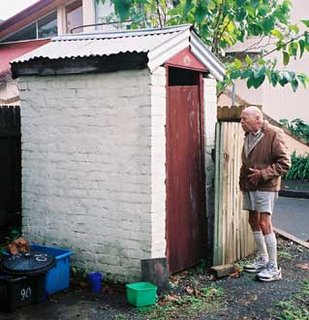
Image: A Sydney man waiting proudly to use this Australian architectural icon.

Wednesday, November 29, 2006

Is Might Right?

F W Boreham tells this story in one of his many books:

“I was in London in 1888, when the Parnell Commission became the centre of world-wide excitement. Lord Frederick Cavendish, the Secretary of State for Ireland, and Mr. Burke, the Under-Secretary, had been murdered by Fenians in Phoenix Park, Dublin. The London Times charged Mr. Parnell, the leader of the Irish Party in the House of Commons, with complicity in the crime; and, to prove it, published a photograph of a letter in Mr. Parnell's handwriting condoning and approving the murders. Mr. Parnell at once declared that the letter was a forgery, and the Parnell Commission—one of the longest and most sensational legal cases of all time—was set up. It ended dramatically.”

“The Times had bought the letter from a man named Pigott for about five thousand pounds. Pigott claimed to have purchased the letter in Paris. Everybody felt that the crucial moment would come when Pigott, in the witness-box, was subjected to the merciless cross-examination of Sir Charles Russell. The great day came. On Wednesday, February 20, 1889, it was known that, immediately after the luncheon adjournment, Pigott would face his ordeal.”

“To the astonishment of the Court, Sir Charles Russell simply handed Pigott—a squat, corpulent, frock-coated figure, obviously extremely nervous—a sheet of paper. `Mr. Pigott' he said, blandly and politely, `would you be good enough, with my Lords' permission, to write some words for me? Perhaps you will sit down in order to do so!' He then dictated several words—‘livelihood', `likelihood', 'proselytism', and so on. And finally, as if it were purely an afterthought; he added the word `hesitancy'. Then, amidst breathless silence, he took the sheet of paper from the witness. Everybody could see from his expression that Sir Charles Russell had got what he wanted, and some even heard Frank Lockwood, Russell's junior, who had glanced at the document, exclaim: `We've got him!' Pigott had spelt the last word 'hesitency'. The same word was misspelt in the same way in the letter in The Times! Pigott left the box—and blew his brains out. The case that had absorbed the attention of the world had reached its climax and conclusion in the substitution of an `e' for an `a'! It was a case of a single letter. Hesitancy: hesitency…..What does it matter? But see how much it reveals!

Might! Right! It is merely a case of a letter. But at this moment millions of people are hazarding their happiness, their homes, their wealth, their very lives to prove that the two words are not synonymous. Might is not right! And rather than bow down to the champions of Might, people who love Right will gladly die.

Source: F W Boreham, ‘Shibboleth’, A Late Lark Singing (London: The Epworth Press, 1945), 143-148.

Image: Sir Charles Russell.

Tuesday, November 28, 2006

Leadership that Empowers

Stymie or Stimulate
Unfortunately many leaders block and stymie the initiative of the people they serve yet the important challenge for leaders is to address this question: How can we leaders better empower our people to use their gifts and get on and make their unique contribution?

Scarcity in the Sahara
It happened in the Sahara Desert during the Second World War where there was a French battalion serving in a very remote area. Because of this food supplies were often scarce and at one stage their clothes were absolutely worn out. All radio requests for new supplies went unheeded until one day the Red Cross dropped from a plane a great big bag of new uniforms. The soldiers were delighted.

But when some of the officers untied the canvas bag they discovered that very few of the clothes had labels and those that did obviously weren’t the size they purported to be! The officers puzzled among themselves wondering how ever they would work out a system so that every soldier got clothes that would fit.

“Debrouillez-vous!”
But while they were nutting out this problem the crusty old French commander stood before the soldiers and simply bellowed out: “Debrouillez-vous!” Which roughly translated means “Sort it out.” “You sort it out!”

All at once there was a massive dive into this mountain of clothes. Here they were thrashing around, trying them on and sorting them out. But before too long all these soldiers were happily fitted out, clothed and in their right uniforms. It all worked out amazingly well except for one poor chap who ended up with two left boots!

Foolish or Gifted
Sometimes when we are appointed to leadership, we think that we are surrounded by fools! We are the experts and every else are idiots. They need us to organise them and sort everything out, to decide, to approve, to control.

The soldiers in the Sahara remind us that our people are not nincompoops and if as leaders we protect them, if we encourage them and empower them they can be trusted to tackle even those things that we as leaders thought were unsolvable.

Geoff Pound

Image: Sahara Scene

Monday, November 27, 2006

Kneel Where Believers Have Knelt

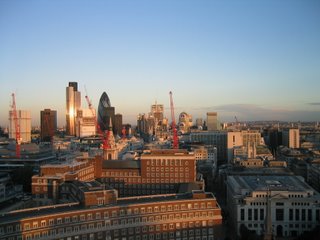
I visited St Paul’s Cathedral recently and at a service of worship under the great dome I thought of the following story and the truth that it contains.

A group of pilgrims were retracing the steps of some of the early Christians in England and in one Cathedral that was centuries old, the tour guide said to the party: "Come forward and kneel here at the communion rail. It's a great thing to kneel at the place where the saints of old have knelt."

Kneeling or sitting at a communion table is what can unite us with believers all around the world.
It is this table that joins us with believers who have run the race yet still cheer us on.
It is this table that takes us back to that upper room and the one who first extended the invitation to gather and dine at the table.

It is at this table that we can commune with the living Christ and truly experience the communion of the saints.

Geoff Pound

Image:

Sunday, November 26, 2006

Gaining True Sight

Don’t Hit Me
A man would often get drunk and come home and beat up his little boy. One day the boy was lying ill in bed and the father, for once was sober. When the father lent over the bed the little boy put up his hands in front of his face and he screamed, “Don’t let him hit me Mummy”. Then the father realized what he had been doing and the harm he had caused while he was drunk.

Detoxing
When we regain our spiritual sight we become aware of our wrong and realize all the harm that we have caused others. We discover that we were so much under the influences of the wrong things that we struck out at the ones who loved us.

Geoff Pound

Image: Testing Sight.

Saturday, November 25, 2006

A Rare Union

Passionate but One-Eyed
It is prevalent for people who are ardent and enthusiastic about something to also be bigoted, one-eyed and dogmatic.

Broad but Uncertain
It is just as common for those who are broad-minded and inclusive to be wishy-washy, lacking in conviction and muted about issues of justice.

A Rare Union
On a recent visit to the St Paul’s Cathedral in London I came across a magnificent tribute to Reginald Heber, Bishop of Calcutta and writer of hymns such as Brightest and Best and Holy, Holy, Holy.

The plaque in the downstairs chapel off the crypt said about Reginald Heber, “his character exhibited a rare union of fervent zeal with universal tolerance.”

Geoff Pound

Image: View of London from St Paul’s Cathedral, the sphere in which character must be expressed.

Friday, November 24, 2006

Saying Yes and No

In a fascinating article Walter Shurden writes:

“I believe that “saying yes and saying no,” is an important spiritual discipline.

Michelle McClendon speaks for many of us when she writes, “One of the spiritual practices that I struggle most with is that of saying yes and saying no." Chew on that line. Surely Michelle put us in touch with something that matters. “Saying yes and saying no” is a spiritual practice of enormous proportions, carrying with it huge implications.

“Saying yes and saying no” is an important spiritual practice as we look at our schedules.

Scheduling is what Michelle was talking about in her email to me, because I had very reluctantly told her no about a speaking engagement. My time, as well as my money, is, of course, a critical issue of stewardship. Deciding which invitations to accept and when to accept them and why—that is a spiritual decision. What responsibilities to take on at church, school, work and in the community is at bottom a spiritual decision that impacts not only me but my family, my colleagues, and my work for God’s kingdom.

John Carleton once said, “All of my invitations come to me in my manic state of mind, and they come due in my depressed state.” Who has not felt that way?

Some of us, burdened with messianism, say yes far too often and far too quickly. Saying yes is often rooted in a distorted need to be needed. Yes can spoil as well as enrich. Some of us overlive. On the other hand, some of us, blighted by a negative view of self, say no far too often, far too quickly, and far too fearfully. Saying no is often rooted in a fear of risking. Some of us underlive. I am confident that some of my yeses should be noes, some of my noes, yeses.

Further discussion by Walter Shurden on this subject can be found at:
http://www.centerforbaptiststudies.org/bulletin/2006/november.htm#Believe

Image: Walter Shurden

Thursday, November 23, 2006

Giving Thanks

On this American Thanksgiving Day it is good to ponder how people can be thankful even amidst difficult circumstances.

In this vein is the story of Joni Eareckson, a 17 year old who decided on a hot day to go swimming. On holiday at America's Chesapeake Bay she swam out to a raft and dived in. But she hadn't realised how shallow the water was and she struck her head sickeningly on the bottom.

Her sister dragged her out and at hospital they found she'd broken her neck and she'd have no movement below her head.

Here was a 17 year old who'd had so much going for her but now she was paralysed.

Several agonising months later she prayed,
"Lord it looks as if you've closed every single door in life. Is there one window left open?"

During one of her lowest times she was visited by a therapist who said: "Joni why don't you try writing and drawing with your mouth?"

At first she was disgusted but she agreed to give it a go and over the years she has developed this unusual skill of painting with a brush between her teeth.

Joni has a lovely voice and she travels around speaking and singing to various groups encouraging people.

One day she prayed,
"Thank you Lord for giving me so much. I have a mind. I can see. I can hear. I can speak, I can read. I have a wonderful Mum and Dad, brothers and sisters. I have many friends. I have the opportunity of talking about you and enjoying your world. Thank you Lord!"

What a grateful attitude Joni has developed in the midst of her difficult circumstances!

Paralysed from the neck down she is doing very well but one of the most charming things is her attitude.

In one of her books she writes:
"There is only one handicap in life, I have discovered. That is living without the knowledge of God. With Him we have everything we need."

More about Joni and what she is up to now can be found at:
http://www.joniandfriends.org/

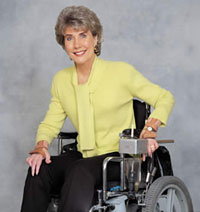
Image: Joni Eareckson Tada

Wednesday, November 22, 2006

Choosing Gratitude

Dr. John Claypool often spoke about the importance of choosing to be grateful. Here is one of his many renditions of the story behind Thanksgiving Day:

“Those of you who know a great deal about the past will undoubtedly agree with me that oftentimes history turns on slender hinges. What I mean is that events that seem at the time to be very small, turn out to have tremendous consequences. This is certainly the case in the earliest days of our country’s formation."

"The story begins in the summer of 1620 when one hundred twenty five eager, Christian folk set out from Southhampton, England, hoping to come to the new world and establish a faith community. They were on two leased ships, the Mayflower and the Speedwell. But as they made their journey around the southern tip of England, the Speedwell developed problems so they both had to pull in to Plymouth. There it was determined that the Speedwell was not able to cross the Atlantic. So twenty of the original group gave up and went back home. One hundred five crowded onto the Mayflower and set out well behind schedule hoping to get to the colony of Virginia in time enough to build some shelter before the winter came."

"Navigation in the seventeenth century was a very primitive affair so it took them a lot longer to cross than they had expected, plus they were blown hundreds of miles off course without realizing it. They didn’t see land until the last part of November and what they saw was not Virginia at all but New England. They had hoped to get there before the winter set in but that was not the case. They went ashore. They were not able to build very substantial shelters and as a result disease began to sweep through the little community."

"Before the spring came to break the terrible cold, exactly half of the original group that had set out from Plymouth were in unmarked graves because they had been devastated by so much disease. It was at that point that what was left of the crew of the Mayflower started to go back to England and the whole group wondered whether or not they should just give up and go back with them. But courage overcame despair and so they decided to stay. At that point their fortunes turned. The Indians were wonderfully hospitable. They shared with them their land, they taught these pilgrims how to plant, and how to cultivate. That summer they built very substantial housing and they were able, when the harvest came in, to be amazed at the fertility of this new country."

"These were religious folk and so when the first anniversary of their being in the new world began to loom on the horizon they wanted to devise some kind of ritual to acknowledge this significant event. Not surprisingly, the first suggestion was that they have a day of mourning. Every family had lost at least one person, many had lost several members of the family. They argued that the best way to commemorate their time there was to remember those who had sacrificed their lives."

"There was another group that said, 'Yes, we have lost a great deal, we have undergone great tragedy and grief, but we also have much to be thankful for. The Indians had been wonderful, the land here is wonderfully fertile, we ourselves have survived. Why don’t we make that first anniversary a day of thanksgiving rather than a day of mourning?' "

"Well the record is that a debate went back and forth between the mourning party and the thanksgiving party. And as you know, because of a national holiday that we still recognize the last of November, it was the thanksgiving party that actually prevailed. So the first anniversary of these hearty people was a day in which they expressed profound gratitude for all the things that were going for them."

"Historians have said that that simple decision to opt for gratitude rather than mourning may have been the most significant factor in giving those people the energy and the courage to meet the challenges that were yet to come. Truth be told, whenever we face ambiguous situations with things going for us and things going against us, I would suggest that gratitude is the most creative thing we can possibly do because it puts us in touch with the positive energies that are at work in our lives. It gives us a way of having confidence and it gives us a way of having hope for the days that lie ahead.”

Source: John Claypool, ‘Ambiguity and Gratitude’ Thirty Good Minutes, 19 October, 2003
http://www.30goodminutes.org/csec/sermon/claypool_4703.htm

Image: Painting of the Mayflower.

Tuesday, November 21, 2006

Looking Up To Greatness

A few years ago during a cricket series between Australia and the West Indies, Ian Chappell, the former Australian cricket captain, conducted an interview with the great West Indian cricketer, Wes Hall.

One of the questions that Ian Chappell put to him was this:

"You are just one of many champion cricketers that hail from the island of Barbados....How is it that such a small island has produced such a large number of top-flight cricketers? What's the secret?"

Without any hesitation Wes Hall said; "The answer is emulation."

With so many cricketers down through the years, every young boy grows up wanting to be like them... To bat like Gordon Greenidge, to bowl like Wes Hall, to field like Frank Worrell or to be an all-rounder like Sir Garfield Sobers.

Not only in sport but in every sphere of life we need people that we can look up to and emulate.

Geoff Pound

Source: Heard on Channel 9’s Wide World of Sport, Australia.

Image: Wes Hall

Saturday, November 11, 2006

The Living of these Days

One of the most influential preachers and religious leader of the 20th century was the minister of the Riverside Church in New York, Harry Emerson Fosdick.

In his autobiography, Dr. Fosdick tells of an experience that happened to him soon after his graduation from Theological Seminary. He wrote –

“In my young manhood I had a critical nervous breakdown. It was the most terrifying wilderness I ever travelled through. I dreadfully wanted to commit suicide, but instead I made some of the most vital discoveries of my life.”

“My little book, The Meaning of Prayer would never have been written without that experience. I found God in a desert.”

It is interesting to recognize that some of life’s most revealing insights come to us, not from life’s loveliness, but from life’s difficulties?

Geoff Pound

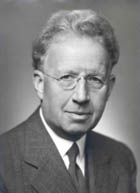
Image: Harry Emerson Fosdick

Friday, November 10, 2006

Naming the Fallen

In a recent Washington Post article entitled 'Requiem for the Fallen Fighters', Brigid Schulte writes of a service which seeks to put faces and names to the grim military statistics beamed by the media each day from the war in Iraq and Afghanistan.

She says, “On the first Monday of every month, the Rev. Robert H. Malm stands before his congregation at a special service and reads the name and rank of every U.S. serviceman or woman who was killed in Iraq or Afghanistan the previous month...”

“The first thing [Malm] notices is that most of the casualties are enlisted men. The officers and the women, those names jump out. But it's the privates, the specialists, the corporals and the sergeants who are dying in Iraq and Afghanistan...”

Every week, the names of the fallen are published in the church bulletin. Every Sunday, the week's death toll is read from the pulpit. Oct. 8: 18 dead. Oct. 15: 31 dead. Oct. 22: 24 dead…. ‘Rest in peace.’

Schulte says “that with the United States deeply divided by the war and its costs, Grace Episcopal Church's actions could be seen as controversial -- political even.” The government and many news services are seeking not to highlight the immensity of the losses.

“But to Malm, the monthly requiem is not about politics. It's not about being for or against the war…. ‘These people need to be remembered,’ Malm said in an interview in his rectory office.

The names are offered as prayers, he explained. And prayer is hard to debate… This war is so confusing, and most of us live in denial. It's easier to go on our merry way, to take care of the economy, our personal needs," he said. "But we all need to have an awareness of this war. And its costs.’"

Those who have died are strangers to him. Not one was a member of the parish. And yet, Malm said, the experience of intoning each of their names is profound.

The idea for the requiem came a few years ago from parishioner Mike Hix, a retired Army colonel who served two combat tours in Vietnam as a young man. He and his wife had traveled to New York one weekend and attended services at the Church of the Heavenly Rest in Manhattan, which was founded in 1865 at the close of the Civil War as a memorial to the soldiers who died in that conflict.

Hix said he sat transfixed as the pastor read the names of the young men and women who had died that week. "As they read those names, it just brought me to tears, and my wife as well," he said. "It was so powerful."

Hix, perhaps more than most, knows that a casualty list is more than a collection of names. "These are real people, with real names. These names have wives and children they've left behind," Hix said.

Malm and Hix keep their personal views on the war to themselves.

But the constant stream of names coming before Malm has had him meditating on the war's costs. What does he think about as he reads the latest list of fatalities? "The profound failure of war," he said. "What has it ever ultimately achieved?"

As Wiggers readied the list of 105 names of those killed in October for the Monday requiem, Malm sighed. "It's just so sad."

Source: Brigid Schulte, ‘Requiem for Fallen Fighters’, Washington Post, 8 November 2006.
The full article can be read at:
http://www.washingtonpost.com/wp-dyn/content/article/2006/11/08/AR2006110800815.html?referrer=emailarticle

Image: Robert Malm

Thursday, November 09, 2006

Eyes Wide Open

Mark Gerzon in his useful book on transforming conflict says:

“Wherever we sit right now, something stops our vision from extending throughout the world. It may be the manmade walls of an apartment building or a school or an institution. It may be the political walls of cities, states, countries, or regions; or the economic walls of wealth and poverty, privilege and oppression. If not these barriers, then it may be the invisible walls of attitudes and ideologies, mind-sets or belief systems. Wherever we live, there are walls-if not of oppression, then of privilege; if not of ignorance, then of sensationalized and incomplete information. This is why developing our integral vision is so essential: it enables us to see through the prison walls of our identity and embrace a wider world.”

“For example, instead of hiding out in his software empire, imprisoned by his wealth, Microsoft CEO Bill Gates has traveled the world with his wife Melinda in order to develop a more integral vision. ‘Some of the worst human tragedies in the world today go on because we don't really see them,’ says Gates. ‘We rarely make eye contact with people who are suffering, so we act sometimes as if the people don't exist.’"

“Making eye contact with the Other is one of the best ways to learn to see through walls. It is the most effective way to develop integral vision.”

Mark Gerzon, Leading Through Conflict: How Successful Leaders Transform Differences into Opportunities, Boston: Harvard Business School Press, 79.

Image: Bill and Melinda with eyes wide open.

Wednesday, November 08, 2006

Give Birth to Your Own Baby


"To demand that others should provide you with answers is like asking a strange woman to give birth to your baby."

"There are insights that can be born only of your own pain, and they are most precious. "

Source: Janusz Korczak, How to Love a Child
http://www.inwardoutward.org/?p=206

Image: Giving birth?

Tuesday, November 07, 2006

Win Win!

One of the goals for someone mediating transformation in a situation of conflict is to get different parties to give some ground in the hope that each side will win.

I think of this when I buy a rug or vegetables at the market where there is no fixed price. In this culture of bartering the outcome is for both buyer and seller to feel they are parting with satisfaction.

The psychology of bartering and conflict mediation is expressed so well by the Italian novelist, Umberto Eco. Baudolino in the book with the title bearing his name, is addressing a touring party that has arrived at Gallipolis:

"You should know that in our markets, at first glance, you wouldn’t want to buy anything because they ask too much, and if you immediately pay what they ask, it’s not that they take you for fools, because they already know you are fools, but they are offended because the merchant’s joy is bargaining. "

"So offer two coins when they ask ten, they’ll come down to seven, you offer three and they come down to five, you stick to three, until they give in, weeping and swearing they’ll end up homeless with all their family. At that point, go ahead and buy, but you should know that the object was worth one coin.”

“Then why should we buy?” the Poet asked.

“Because they also have a right to live, and three coins for what is worth one represents an honest trade.”

Source: Umberto Eco, Baudolino Trans. William Weaver (London: Vintage Books, 2003), 285.

Image: Bartering at the markets.

Communicating By Gesture

F W Boreham tells this story about the essence of communication:

One Universal Language
There is only one really universal language. It was spoken in the world's first morning, and people will still be speaking it when they are startled by the shocks of doom. The little child speaks it before she is able to lisp one single word of our clumsier dictionary speech; and the aged speak it long after the palsied lip has lost its utterance.

Common to All Cultures
It is known in every latitude. 'I used to think,' says Hugh Cairncross, in the course of one of his travel-stories, 'I used to think that, in order to invade successfully all the out-of-the-way corners of the globe, it would be necessary for me to master a score of languages. I soon discovered my mistake. I have made my way up the Amazon, up theYangtse, up the Ganges, up the Danube, and up the Nile; I have moved among pigmies in the African jungles, among Red Indians beside the Canadian lakes, among South Sea Islanders in the Pacific, among the Eskimos in the frozen North, and among all the European and Asiatic peoples; yet I know nothing of their languages save a smattering that, in spite of myself, I have picked up in the course of my gipsyings among them. My experiences have taught me that there is a wondrous magic in the skilful use of gesture. What cannot be said by the movements of one's muscles, the manipulation of one's fingers and the expressions of one's face is not worth saying.'

Mr. Cairncross declares that there is no outlandish spot on earth, however barbaric, which he could not enter with the certainty of being able to make himself immediately intelligible to the natives by means of gesture.

Divine Communication
Is it any wonder, then, that when, in the fulness of time, God had something to say that God would have all people understand, God’s expression comes, not in Hebrew or Greek or Latin, but in this one universal speech? God adopted a striking and dramatic gesture.

Source: This is the opening to F W Boreham’s essay, ‘Beau Geste’, The Passing of John Broadbanks (London: The Epworth Press, 1936), 235-244.

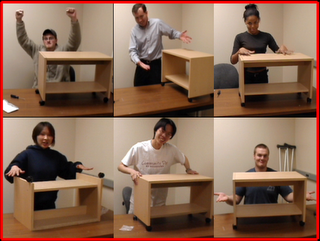
Image: Get the Message?

Monday, November 06, 2006

Just By Coincidence

Coincidentally
Do you ever think much about the coincidences that have happened in your life?

F W Boreham wrote an article about some of the amazing coincidences that happened to him and said:


Committing Coincidences to Print
“No person should think seriously of dying until they has committed to paper a list of the most striking and extraordinary coincidences that have come under their personal observation. I do not mean those of which he has read. As I have tried to demonstrate in A Reel of Rainbow, the stately coincidences of history are tremendously impressive and dramatic. But they are common property: anyone can collate them.”

Reflecting on Their Value
“In the course of each person’s personal pilgrimage, however, they encounter a few combinations of circumstances so arbitrary, so fortuitous and so bewildering as to be almost freakish. Were a novelist to weave them into the web of their romance, the reviewers would charge the novelist with having transgressed all the bounds of probability. The plot would be condemned as a flagrant outrage of the literary canons. Yet these things actually happened! If each person were to recall and record such surprising experiences whilst it is still in their power to do so, some very valuable and practical purposes would be served.”

Concrete Coincidences
“Let me crystallize my abstract doctrine into concrete example by a few instances of the kind of thing I have in mind. I will begin with my wedding day. We were married at Kaiapoi, New Zealand, early in the morning and caught that day's express for the south. A friend, knowing of our movements, sent a congratulatory telegram to the train. The guard handed it to me—opened!
`Very sorry, sir', he murmured, `but there's another young couple of the same name in the next carriage!'”

“In view of the fact that my name is not a particularly common one, an involuntary doubt sprang to my mind; but, later on, we met our namesakes, who were most profuse in their apologies.”

If you would like to read more of Boreham’s amazing coincidences and his reflections on them, check out the series starting today on The Official F W Boreham web site.

This entire essay will be included in the forthcoming book, The Best Essays of F W Boreham.

Source: F W Boreham, ‘The Long Arm of Coincidence’, I Forgot to Say (London: The Epworth Press, 1939), 87-96.

Image: Coincidence on the Canterbury Plains

How's this for open hospitality?

I visited a modern mall in Bandung, Indonesia recently that had signs at its entrances welcoming dogs and other pets. This must be an incentive to shoppers to stay longer in the shops and spend more!

This reminded me of the following story about putting out the welcome mat for canines:

A man wrote a letter to a small hotel in a Midwest American town that he planned to visit on his vacation.

He wrote: "I would very much like to bring my dog with me. He is well-groomed and very well behaved. Would you be willing to permit me to keep him in my room with me at night?"

An immediate reply came from the hotel owner, who wrote:

"I've been operating this hotel for many years. In all that time, I've never had a dog steal towels, bedclothes, silverware or pictures off the walls. I've never had to evict a dog in the middle of the night for being drunk and disorderly. And I've never had a dog run out on a hotel bill. Yes, indeed, your dog is welcome at my hotel. And, if your dog will vouch for you, you're welcome to stay here, too."

Source: The Joke Doctor. TheJokeDo ctor.com

Image: Great dane enjoying hotel hospitality.

Sunday, November 05, 2006

Imagining Peace Together

Travelling in New York some years ago, my wife and I spent some hours in Central Park. On our walk we came across three acres dedicated to the memory of John Lennon. They’re called ‘Strawberry Fields’ and they contain plants and trees from more than 100 countries of the world.
This was the place the former Beatle loved to frequent and it’s just over the road from his apartment on seventy-second street where Lennon was shot and killed on 8 December, 1980.

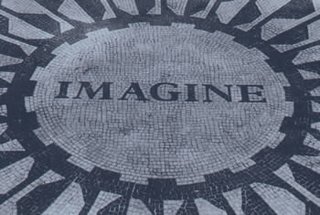
On a path in the fields is a circle with lines radiating outwards. In the middle of the circle is the one word, ‘IMAGINE.’ Several people were sitting there in silence on park benches. Floral tributes were strewn across this memorial.

I love the tune of that song;

I love the encouragement to imagine ‘all the people living life in peace.”

I love the invitation to imagine together in the words:
“You . . . you may say I’m a dreamer
But I’m not the only one.
I hope some
day you’ll join us.”

To imagine peace together and discover ways of making peace is still relevant two decades after this invitation was first extended.

Geoff Pound

Image: Plaque on the path in Strawberry Fields.

Saturday, November 04, 2006

Seeing the World as a Whole

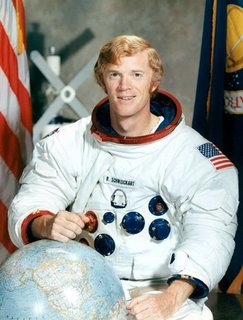
Russell Schweickart was born in New Jersey, 1935 but he became famous as an American astronaut. Following his orbiting of the earth for ten days in March 1969 he wrote this article that invites people to see the world as a whole.

BUT UP THERE you go around every hour and a half, time after time after time. You wake up usually in the mornings, over the Middle East and over North Africa. As you eat breakfast you look out the window and there's the Mediterranean area, Greece and Rome and North Africa and the Sinai, that whole area. And you realize that in one glance what you're seeing is what was the whole history of humankind for years - the cradle of civilization.

And you go down across North Africa and out over the Indian Ocean and you look up at that great subcontinent of India pointed down toward you as you go past it, Ceylon off to the side, then Burma, Southeast Asia, out over the Philippines and up across that monstrous Pacific Ocean, that vast body of water - you've never realized how big that is before. And you finally come up across the coast of California, and you look for those friendly things, Los Angeles and Phoenix, and on across to El Paso. And there's Houston, there's home, you know, and you look out, and you identify with it.... And you go out across the Atlantic Ocean and back across Africa, and you do it again and again and again... And it all becomes friendly to you.

And you identify with Houston and then you identify with Los Angeles and Phoenix and New Orleans. And the next thing you recognize in yourself is that you're identifying with North Africa. You look forward to it, you anticipate it, and there it is. And that whole process of what it is you identify with begins to shift. When you go around the Earth in an hour and half, you begin to recognize that your identity is with the whole thing. And that makes a change.

You look down there and you can't imagine how many borders and boundaries you cross, again and again and again, and you don't even see them. There you are - hundreds of people in the Middle East killing each other over some imaginary line that you're not even aware of, that you can't see. And from where you see it, the thing is a whole, the earth is a whole, and it's so beautiful. You wish you could take a person in each hand, one from each side in the various conflicts, and say, "Look. Look at it from this perspective. Look at that. What's important?"

Source: Russell Schweickart, No Frames No Boundaries, Rediscovering the North American Vision, Summer, 1983, Context Institute.

Image: Russell Schweickart