Friday, October 06, 2006

Candlesticks of Forgiveness

The musical, Les Mis, is based on the novel by Victor Hugo, Les Miserable, In that musical, there is a wonderful story of a convict who was a hardened, mean man and had been in jail for ten years, doing hard labour in chains.

He was finally set free, but he had a convict card. He couldn't get a job; he couldn't even stay in a hotel room. He went to a bishop's house. The bishop let him stay over night. In the middle of the night when everyone went to sleep, the convict got up, stole a silver candle stick and crept out of the bishop's house and took off through the woods.

He was caught. He was caught by the French policemen. They came in the middle of the night, woke up the bishop and said, "We've got him, this lying, conniving thief. We've got him. This time we are going to put him away for life."

The bishop turned to this man cowering in chains and said, "That's no thief. That's my guest, Jean Valjean, but I gave him two candlesticks, not one. He forgot one." He reached in a drawer and gave him another silver candlestick. The police had to let him go.

That experience of forgiveness for something he had done wrong, that unfair act of forgiveness seeped down inside of Jean Valjean. He kept those candlesticks for the rest of his life as mementoes of what the bishop had done.

Source: Told by Philip Yancy on 30Good Minutes.

Image: Candlesticks

Thursday, October 05, 2006

Condensed Life

No Time For Reading
Dale Roberts, North Carolina College Career Counselor, is plotting a dream which illustrates the fast pace of modern life.

He asks, “Have you experienced the thrill of intellectual accomplishment, the deep and abiding sense of achievement that comes after reading one of the great classic books of Western civilization? Me neither.”

The problem with those great books is they are so-o-o-o-o lo-o-o-o-ong. Those guys had way too much time on their hands.

Long Book Simple Plot
Take "Romeo and Juliet." What happens, really? Two Italian teenagers fall in love, but their families hate each other. Things don't work out, and they both end up dead.
I tried reading shorter classics, like "The Old Man and the Sea": An old guy goes fishing and hooks this humongous fish. It's hard to catch, but he catches it. On his way home some sharks eat it. They told me this Hemingway guy wrote short and to the point. Wrong!
I looked for versions of classics that wouldn't waste my time. I tried the Reader's Digest condensed Bible, but I got bored reading about the Nine Tribes of Israel and the Seven Commandments. I tried Cliffs Notes - still too long.

New Book Range
Then it came to me: I'll publish my own library - "Great Book Cards of the Western World." The cards are 3-by-5 inches - just the right size for pocket or purse.

Some forthcoming entries:
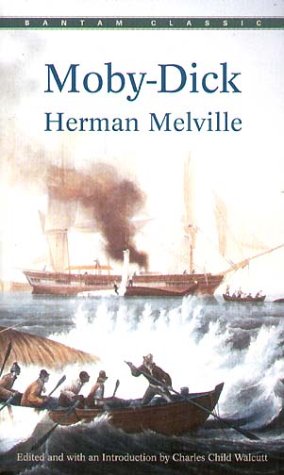
"Moby Dick" - A guy named Ahab is hunting a white whale when he falls in the water and the whale bites his leg off. He goes crazy and tries to find the whale and get even. He finds the whale but the whale sinks his ship and Ahab gets killed.
"The Grapes of Wrath" - During the Depression, the Joad family in Oklahoma loses their farm and falls on hard times. They pack up their stuff and drive to California, but things aren't so great there either.

I'll also do nonfiction: "The Prince" by Machiavelli - Look out for Number One. You can fool some of the people some of the time, and usually that's enough. Watch your back.

Inspiration in Dozen Seconds
You can read each of my book cards in 10 seconds. Just the thing when you're in line at the supermarket or stopped at a red light. My first series of book cards will include 100 titles. Readers can buy them individually. If they buy all 100, I'll throw in a diminutive bookcase.
After I publish the first series of books, I might do a bigger project: a book-card edition of the encyclopedia.

You got a minute?

Source: Dale Roberts, ‘Backstory: Great Books Reduced to a Pinhead’ CS Monitor, 22 September 2006.
http://www.csmonitor.com/2006/0922/p20s03-algn.html?s=hns

Image: Moby Dick

Wednesday, October 04, 2006

Age With Creativity

Patricia Brown has written a fascinating article on a new style retirement community in Burbank, California.

Fostering Self-Expression
In this colony Suzanne Knode from Apartment 406 has written a comedy movie in which the leading lady is a downstairs neighbour, 81 year old Ms Nichols from Apartment 125.

Brown reports: “With the understanding that not everyone wants the old-school model of golf course retirement, the colony offers artful self-expression: a digital film editing laboratory, a theater, drama classes and studios open for inspiration 24 hours a day.”

Discovering Your Picasso
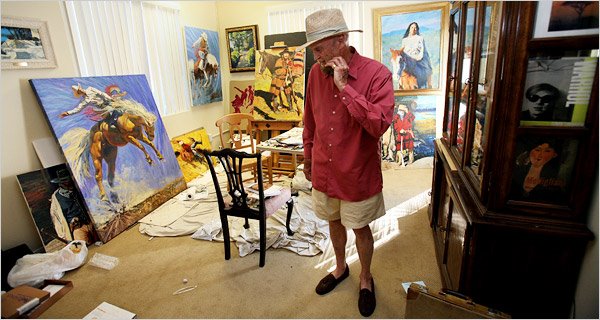
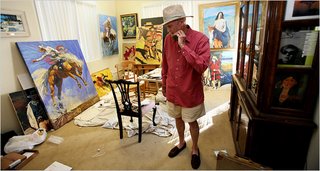
“This is a place where amateurs discovering their inner Picassos in retirement can commune with working pros like Charlie Schridde, a painter in his 70’s from the ‘cowboy impressionist’ school who resembles the grizzled trappers of his canvases.”

Model for Creative Aging
“The colony, was recognized last month as a model for creative aging by the National Endowment for the Arts, represents a profound shift in thinking about aging. In 2001, a study co-sponsored by George Washington University and the N.E.A. found that people 65 and older who were regularly involved in participatory arts programs reported fewer doctors’ visits and less need for medication and were less prone to depression.”

“Residents appear frequently as guests on “Experience Talks,” a weekly radio program on KPFK that is produced by More Than Shelter for Seniors, the nonprofit organization that conceptualized the colony.”

“The show, which reaches 250,000 listeners, features interviews with celebrities like Andrew Weil, the alternative health guru, and Studs Terkel-like celebrations of the residents themselves, the most recent a tribute to Buck Page, one of the country’s last singing cowboys, who released a CD not long before his death a few weeks ago, at an effervescent 84.”

Life Coming Back
“The colony, Mr. Freedman said, ‘is a new hybrid that moves beyond that to actual creativity, to growth.’ He added: ‘It’s not just writing memoirs and harvesting the past. It’s about producing new insights and work that is not only personally interesting but enriches the lives of neighbours.’”

“The new Burbank colonists include Gene Schklair, a retired dental surgeon from Chicago who is now sculpting full time. Before moving to the colony, Mr. Schklair and his wife, Glorya, both 75, spent a year backpacking around the world after he contracted a serious illness, from which he has recovered. ‘You see them come in with dead eyes,’ he said of new arrivals, some of whom are art appreciators rather than artists. ‘Then, the life comes back.’”

Finding Yourself
“A typical week finds a blues singer performing at the Tuesday barbecue, a novelist offering a manuscript for dissection in a writer’s workshop, and a buff 72-year-old coach teaching how to prevent falls. ‘The same neurons fire whether you’re writing a short story that may or may not be great or whether you are writing Ulysses,’ Mr. Carpenter said.”

“Like a challenging painting, life at the arts colony has become an exercise in perspective. ‘You meet yourself,’ she said. ‘You find out who you really are.’”

Source: Patricia Leigh Brown, ‘At New Rentals, the Aim is to Age with Creativity’, New York Times, 10 September 2006.

Image: Charlie Schridde in his living room and art studio at the Burbank Senior Artists Colony, home to writers, sculptors, actors and other artists.

Tuesday, October 03, 2006

Accepting Forgiveness

In a famous court case in the United States a man was tried and found guilty and sentenced to death.

His lawyers worked hard to get the man a reprieve and eventually they were successful.

With great joy they went to his cell on death row and they showed him the reprieve and to their amazement he refused it.

It then became a famous legal debate.

They studied it carefully and they came to the conclusion that a reprieve is no more than just a piece of paper until it is personally accepted.

Geoff Pound

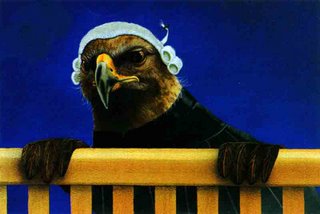
Image: Legal eagle

Monday, October 02, 2006

Blind Comment

I'm a counsellor who helps coordinate support groups for visually-impaired adults. Many participants have a condition known as macular degeneration, which makes it very difficult for them to distinguish facial features. I had just been assigned to a new group and was introducing myself.


Knowing that many in the group would not be able to see me well, I jokingly said, "For those of you who can't see me, I've been told that I look like a cross between Paul Newman and Robert Redford." Immediately, one woman called out, "We're not THAT blind!"

Image: Paul Newman

Source: From AndyChaps "The Funnies"

Brought by way of Sermon Fodder

Sunday, October 01, 2006

Student or Attender of Lectures?

Once someone was talking to a great scholar about a young man. He said, “Someone tells me that he was one of your students.”

The teacher answered devastatingly, “He may have attended my lecture but he wasn’t one of my students.”

There is a world of difference between attending lectures and being a student.


Geoff Pound

Image: Students?

Saturday, September 30, 2006

Diamonds and Oranges

After the ship the Titanic sank, one of the survivors told about a woman who had been allotted a place in a lifeboat. She said, “Can I go back to my room?” The sailor said, “Yes, you have got three minutes.”

The woman hurried along the corridors of the sinking ship. She saw people snatching at their jewelry as they ran. When she got to her room she took no notice of the jewelry and other treasures. Instead she snatched at three oranges and she took them back to the lifeboat. An hour before it would have been incredible to that woman that she would have preferred even a whole crate of oranges to one small diamond but destruction had boarded the Titanic and with one awful blast all her values where transformed.

Precious things became worthless, worthless things became precious, oranges were more important that diamonds.

Geoff Pound

Image: Precious oranges

Friday, September 29, 2006

Newness From The Rubbish

Maria Sherwood was born in Sussex England in 1799. At the age of 19 she married Thomas Smith and in 1838 they both migrated to Australia.

In 1855 and 1856, Thomas and Maria Smith bought a farm around Eastwood, New South Wales where they became orchardists. They specialized in raising different types of fruit one of which became known as the Granny Smith.

The earliest account of the origin of the Granny Smith appeared in the Farmer and Settler of 25 June 1924, in an article by Herbert Rumsey, a Dundas orchardist and local historian. He interviewed local fruit-grower Edwin Small who recalled that in 1868 he and his father had been invited by Maria to examine a seedling apple growing by a creek on her farm. She explained that the seedling had developed from the remains of some French crab apples grown in Tasmania.

It is amazing how such a firm and fresh variety of apple emerged from the discarded crab apples thrown onto the rubbish heap.

In Eastwood Australia they still celebrate this new fruit and tell this story about worthwhile things emerging from that which others think is refuse.

Image: Granny Smith

Thursday, September 28, 2006

Right Diagnosis

One of the most interesting writers of childrens’ stories in recent times is Roald Dahl.

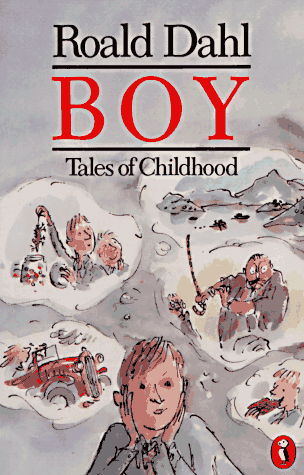
In his book about his own life, entitled “Boy”, he tells how his father, as a young man, slipped and fell off the roof and broke his left arm just below the elbow. Someone called the doctor and when the doctor showed up he didn’t realize the arm was broken and he decided Mr. Dahl had a dislocated shoulder. He said, “Don’t worry, we’ll soon put this back into place.” So he called two neighbors and they held the patient around the waist and the doctor grabbed him by the wrist of the broken arm and shouted, “Pull! Pull as hard as you can!”

It sounds rather painful! The victim screamed but by this time the damage had been done and a splinter of bone was sticking out through the skin.

This happened back in 1877 and because orthopedics then wasn’t what it was cracked up to be, they simply amputated the arm at the elbow.

It is a good thing to have the correct diagnosis before we start into the treatment.

Source: Boy.

Image: Cover of Boy.

Wednesday, September 27, 2006

I Want Real Human Moments

One of the many great monologues in the contemplative, existential, experimental film Waking Life is Soap Opera Woman's (Tiana Hux) response to bumping into The Dreamer (Wiley Wiggins) and explaining her need for human interaction:

"Hey, could we do that again? I know we haven't met, but, I don't wanna be an ant, ya know? I mean, it's like we go through life with our antennas bouncing off one another continuously on 'ant autopilot' with nothing really human required of us. 'Stop,' 'Go,' 'Walk here,' 'Drive there.' All action basically for survival. All communication simply to keep this ant colony buzzing along in an efficient, polite manner. 'Here's your change,' 'Paper or plastic?', 'Credit or debit?', 'Do you want ketchup with that?'

“I don't want a straw. I want real human moments. I want to see you. I want you to see me. I don't want to give that up. I don't want to be an ant. Ya know?”

Source: Film- Waking Life, 2001.

Image: "I don't wanna be an ant."

Tuesday, September 26, 2006

Fighting For Rights

There is a powerful speech of defiance in the 2001 film Ali.

In this film on the life of the famous boxer Cassius Clay/Muhammed Ali (played by Will Smith) gives his reason for refusing to serve in Vietnam:

"I ain't draft dodging. I ain't burning no flag. I ain't running to Canada. I'm staying right here. You want to send me to jail? Fine, you go right ahead. I've been in jail for 400 years. I could be there for 4 or 5 more, but I ain't going no 10,000 miles to help murder and kill other poor people.”

“If I want to die, I'll die right here, right now, fightin' you, if I want to die. You my enemy, not no Chinese, no Vietcong, no Japanese. You my opposer when I want freedom. You my opposer when I want justice. You my opposer when I want equality.”

“Want me to go somewhere and fight for you? You won't even stand up for me right here in America, for my rights and my religious beliefs. You won't even stand up for my right here at home."

Source: Ali.

Image: The boxer.

Monday, September 25, 2006

New Boreham Books in the Pipeline

Press Release: New Books By F W Boreham

New Boreham Publishing Initiative
Michael Dalton (USA) and Geoff Pound (UAE) have teamed up to establish John Broadbanks Publishing. Both enthusiasts of the writings of Boreham their dismay at the general unavailability of these writings due to their being out of print has led to this exciting decision.

Despite a resurgence of interest in the life and books of Dr F W Boreham no contemporary publisher has yet been willing to risk republishing the books of a preacher and essayist who has been in his grave for almost 50 years.

Prolific Writer
F W Boreham lived in England, New Zealand and Australia between 1871 and 1959. He authored 55 books, wrote 3,000 editorials in major papers and was a premiere preacher. Epworth Press, which published and reprinted most of the Boreham books said his book sales went into the millions and that “Boreham was the biggest catch since John Wesley.” He was introduced at an international conference of pastors in 1936 as “the man whose name is on all our lips, whose books are on all our shelves and whose illustrations are in all our sermons.”

First Book
This new vision is to republish some of the Boreham books that are not only out of print but are exceedingly scarce in the second hand market. The first reprint will be Boreham’s tribute to his mentor. It was first printed in 1948 with the title The Man Who saved Gandhi and will be given the new title Lover of Life: F W Boreham’s Tribute to His Mentor.

It is hope this book will be available by the end of 2006. Further information has been posted and will be added at the following site F W Boreham On Mentoring.

Further Books Planned
The plan also involves repackaging some of the Boreham essays and sermons into two new books, The Best Essays of F W Boreham and The Best Stories of F W Boreham.

It is hoped these books will emerge in 2007. Further information has been posted and some of the stories will be added to the following site The Best Stories of F W Boreham.

Michael and Geoff are grateful to have the permission of Whitley College which has held the copyright to Boreham books since this was passed over by the Boreham family in 1996. A proportion of any profits arising from this new publishing venture will continue to be donated to Whitley College for the training of pastors and missionaries, two ministries that were dear to the heart of F W Boreham.

As this is a ‘self-publishing’ activity donations are being sought to assist in the seeding of this venture.

If you would like to invest in this exciting project you can donate money by writing your check, payable to ‘Michael Dalton’ and send to:

Michael Dalton
2163 Fern Street
Eureka, CA 95503
USA

The selection process of the best essays and stories is happening now. If you would like to put in a recommendation for a favorite essay or a story to be included in the new books do write to Geoff Pound geoffpound@yahoo.com.au

If you desire more information or if you would like to register your interest in purchasing these books do write to
Michael Dalton at dalton.michael@sbcglobal.net or
Geoff Pound at geoffpound@yahoo.com.au

Geoff Pound
Michael Dalton

Sunday, September 24, 2006

Handles and Humans

The Japanese author, Kosuke Koyama, once addressed a gathering in New Zealand.

He remarked that most things—car doors, coffee mugs and lunch boxes—all have handles.

Koyama then got a child to come to the front and he asked the child, “Where’s your handle?” Taking the child’s arm he asked, “Is this your handle?” Pointing to the child’s nose he said, “Is this your handle?”

After a humorous examination with the child they both arrived at the conclusion that “Children don’t have handles. Human beings are not made with handles.”

Only things have handles. Handles are there so we can use things. Children are not things. Humans are not things. Human beings are not to be used like things.

Geoff Pound

Source: Thanks June!

Image: Child without a handle

Saturday, September 23, 2006

The Most Memorable Graduation Speech

John Claypool tells the following story about one of Sir Winston Churchill’s famous speeches:

“Back in 1965 something happened that has never happened, I'm told, before or since.
There was a commencement address given at a university in the central [part] of England that is remembered by everybody there verbatim. Can you imagine? Most commencement addresses are easily forgotten. Most of them are platitudinous, and you just sit there hoping to get through as quickly as possible."

"But at one moment in history, a graduation address was given that everybody there remembers word for word. The speaker was Winston Churchill. By this time he was a very old man, very feeble of body. He'd been asked to give this address, and they had to help him up on the stand because he was so weak. In fact it was the last time he ever appeared in public. When he was introduced, they had to help him to the podium, and those there said that he stood there for a long time gripping the podium. They weren't even sure he had strength enough to speak."

"But then, they said, he lifted that great head of his and that voice that had called England back from the very brink of despair during World War II, that great voice said the last public words that he'd ever utter. And do you know what they were? 'Never, never give up. Never give up.' And with that, he just turned around and took his seat."

"They said he was absolutely electric. If you know Churchill's career, time and again he'd been knocked to the ground by failure. Time and time again when it would have been easy to give up. Time and time again when he could have become complacent. But he continued to press toward the mark for the prize.”

Source: John Claypool
http://explorefaith.org/LentenHomily03.10.99.html

Image: Winston Churchill

Friday, September 22, 2006

Pace of Life

A father once found this note pinned to the bulletin board by the telephone:

"Dad, I'm going to wash my hair.

If Tom calls, tell him to call back at 8.

If Brian calls and Tom doesn't, tell Brian to call back at 8.

But if they both call, tell Brian to ring at 8.15 or 8.30.

If Tim calls and Tom and Brian don't, tell Tim to call at 8, but if they both call i.e. Tom or Brian or one calls, tell Tim to call at 8.30 or 8.45,

Signed Tina!”

Know any teenagers who travel thru life at that sort of pace?

Geoff Pound

Image: Pace of Life

Thursday, September 21, 2006

Invaluable in Small Parts

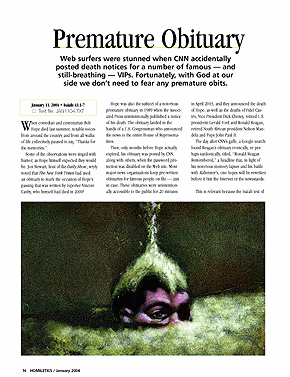
Several years ago there was a spate of premature obituaries.

A Republican, [Bob Stump], stood up in the American Congress and announced that Bob Hope had died. A hush fell on Capitol Hill followed by several solemn tributes. The trouble was, or the pleasant truth was, that Hope was at home in Los Angeles, munching his breakfast.

When the fact became known mourning gave way to mirth. His daughter said he was fine and people began quoting Jesse Jackson's famous line: "Keep Hope alive!" "Keep Hope alive!"

Then a week or two later, the news rippled across the stock exchange that Australia’s Kerry Packer had died. But, Kerry was in London doing business between polo matches. A spokesperson said, "The rumours are totally unfounded and that Packer was annoyed—how would you feel if somebody thought you were dead?"

Sometimes such mistakes have evoked humour as when Mark Twain said, "Reports of my death have been greatly exaggerated."

Sometimes they've led to a change of lifestyle. When an obituary was mistakenly inserted for Alfred Nobel instead of his relative, Alfred was shocked to see himself described as the explosives baron.

He didn't want to be remembered for inventing dynamite or sparking international warfare! So he set about investing his fortune in the most highly regarded award so that his name would always be associated first and foremost with the Nobel peace prize.

One other occasion, the American actor Charles Brookfield opened up the paper to read his own obituary. Again someone hadn't checked the facts. It was a salutary experience for there was one line he never forgot. His obituary read: "Charles Brookfield was never a great actor, but he was invaluable in small parts!"

I don't know whether Brookfield was flattered or flawed by this tribute but sometimes it seems that effective living is exclusively and wrongfully portrayed by the Hamlets and the Lears—in terms of the great actors playing out on some grand stage.

Geoff Pound

Image: Premature Obituary

Wednesday, September 20, 2006

People of the Commas

The United Church of Christ in the USA has the interesting (and for some people controversial) motto, 'God is still speaking.' Some people take umbrage with this statement feeling that God has spoken in the Bible, full stop.

Ron Buford, of the national office of the UCC , was wondering, “How could we state simply the gist of who we are, our uniqueness on the religious scene?” One night it came to Ron, the phrase, “God is still speaking,” capturing the idea that our faith is dynamic, growing, open to new truths, not settled on one orthodoxy.

Ron soon uncovered an old quote from Gracie Allen, the comedian married to George Burns. As she was dying, she wrote her husband a letter in which she said, “George, never place a period where God has placed a comma.” In other words, it’s not over. My death will not be the end of things, not for you, not for me, not for us. It’s only a comma, not a period. The perfect text for a church that believes that 'God is still speaking.'

It is a good thing to reflect on what it means to be a people of the comma!

Geoff Pound

Source: Rich Smith, ‘Good News From the Still Speaking God.’
<http://www.westmorelanducc.org/sermons/2004-7-12/12-19-04.html>

Image: Comma

Tuesday, September 19, 2006

No Full Stop

"When is an ending not an end? When a dead man rises from the tomb, and when a Gospel ends in the middle of a sentence." So writes Lamar Williamson about the end of Mark’s Gospel. "The women went out from the tomb, for terror and amazement had seized them; they said nothing to anyone, they were afraid for..."

In her address about this never ending Biblical story Dr Cynthia Campbell writes: “That’s how it reads in Greek, ending the sentence and the Gospel with a preposition. The most important story of the Christian faith just stops and the end just hangs out there. And we are left waiting, unresolved.”

“The English translation solves that problem by moving the preposition: ‘They said nothing to anyone, for they were afraid.’ That solves the problem with the sentence, but not with the Gospel. Several ancient versions of the Gospel attempted to solve this problem by adding another ending. You will see those printed in your Bibles. But the style of writing is so different that you can tell, even in English, that these were added by another hand, by someone who wanted to make Mark’s Gospel sound like the others, by someone who wanted an end. Even back then, there was some editor who was saying: ‘We can’t have this. We need a conclusion! We need to wrap this up so that, to mix the media metaphor, we can bring up the background music, roll the credits and let people leave with a good feeling about this.’ We can’t have: ‘they said nothing to anyone for they were afraid!’”

“But obviously, they did. They told someone, who told someone, who told someone else, who told a lot of people, because 40 years later Mark is writing this Gospel. And nearly 2,000 years later here we are believing and sharing it.”

“But maybe that’s the whole point. Maybe this story has no end, at least not yet. Perhaps this awkward sentence with its preposition at the end is Mark’s way of saying: ‘This story isn’t over because now it’s your story and mine.’ This is something like one of those plays where the audience gets to vote on how the play ends after a break in the action. Only in this case, it’s the audience that gets to live the end.”

“When is an ending not an end? When the end is just the beginning of a story about eternal and abundant life. Amen.”

Source: Dr Cynthia Campbell on Thirty Good Minutes
http://www.30goodminutes.org/csec/sermon/campbell_4427.htm

Image: St Mark

Monday, September 18, 2006

Never Ending Story

Story tellers like Agatha Christie, O’Henry, Jeffrey Archer, Dan Brown and J K Rowling have been popular because they keep you turning the pages and they are experts at writing conclusions.

Italian folk tales, like good parables, often end in the most unexpected ways. Sometimes writers use red herrings (that lead readers to guess an incorrect outcome), other times there are cliff hangers (leading us to ask, ‘Whatever is going to happen?’) and often there is the deus ex machina technique in which there is an unexpected resolution to an unsolvable situation.

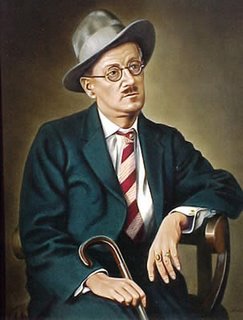
In James Joyce’s last novel Finnegan Wake he ends in mid-sentence. There’s no punctuation. There’s no full stop. It just ends with the sentence incomplete. There’s not even an explanation. When asked about the oddities in his books like this one he said, “I’ve put in so many enigmas and puzzles that it will keep the professors busy for centuries arguing out what I meant and that’s the only way of ensuring one’s immortality.”

What does it mean for a book to have no ending? It may be the novelist’s way of indicating the unending cycle of life or the novel’s plot. It may be a way of saying it keeps on happening. Or, it is his way of saying, “You’ve got to draw your own conclusions.”

The book is not incomplete for it simply reconnects us to the beginning just as the Bible doesn’t drop us at the end but its vision of a garden makes a continuous circle.

T S Eliot put it this way: “In the end is my beginning.” (Four Quartets)

Geoff Pound

Image: James Joyce ‘ensuring his immortality

Sunday, September 17, 2006

Asking Questions

A young girl was going for a drive in the countryside with her father and as they went she was asking him questions.

Looking out her side of the car she said, "Daddy what do you think they're growing in those fields out there?" And he looked across and noticing the green shoots he said, "I don't exactly know."

A few kilometres on they drove through some hill country and she asked, "How high is that mountain over there? And Dad peered through the windscreen and said, "Awww I couldn't be sure."

Further down the road they passed a lake and the daughter piped up again and she said, "How deep is that water?" He glanced down and with a look of hesitation he said, "It's hard to say."

Then the little girl said, "Daddy, you don't mind me asking these questions do you?"
He said, "Of course not. How else will you ever learn!?"

Geoff Pound

Image: Asking questions.

Saturday, September 16, 2006

Forgetting The Point

A young couple had just got married and to celebrate they bought a large ham.

They were a liberated couple who did the cooking together but the husband was rather shocked to see his new wife cutting off both ends of good meat before they started cooking it.

He said: “Why are you doing that?”
She said: “I don’t know, this is the way my mother always prepares a ham.”

The man was intrigued and next time they were around at the in-laws place, he said to his mother-in-law:

“Tell me, why do you cut off both ends of a ham before cooking it?”

She said: “I don't know, that’s the way my mother always cooked a ham.”

By this time the young man was really curious and the next time they were at grandma’s place, he asked her the same question:

“Grandma, why do you cut off both ends of a ham before cooking it?”

And she said, “Oh, the answer to that is very simple.....
That’s the only way it will fit in my pan!”

Many things starts out with a specific purpose, but over the years they become routine until we are just going through the motions without the slightest idea of what we are doing and why we are doing them.

Geoff Pound

Image: Ham fitting in the pan.

Friday, September 15, 2006

The Answer Is In Our Hands

An old man was often sought out for advice and he was greatly admired for his wisdom.

One day a young man thought he would be smart and outwit the sage. He found a small bird that had fallen out of its nest and grasping it in his hand he decided he would say to the man, "Is this bird dead or alive?"

His trick was that if he said, “Its alive,” he would give it a quick squeeze and show him the dead bird. But if he said it was dead, he would open his hand and let the bird fly away. Either way he would be right.

He approached the man with the bird and asked:
“Mr Wise Man, is this bird dead or alive?”

Without looking at his hand the old man replied:
“It is whatever you want it to be.”

On so many issues of life and death, growth and decline it is a matter of whatever we want them to be.

Geoff Pound

Image: Bird in the hand

Thursday, September 14, 2006

If I Had My Life Over Again

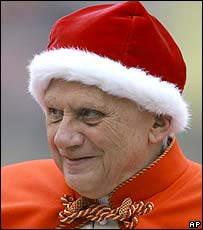
In his book The Shoes of The Fishermen, Morris West relays a conversation between two cardinals who had gathered to elect a new Pope.

Cardinal Rinaldi said, "What would you do if you had to begin again?"

"I've thought about it often," said Leone heavily.

"If I didn't marry—and I'm not sure but that's what I needed to make me half human—I'd be a country priest with just enough theology to hear confession and just enough Latin to get through Mass and the sacramental formulae. But with heart enough to know what griped in the guts of other men and made them cry into their pillows at night.

I'd sit in front of my church on a summer evening and read my office and talk about the weather and the crops and learn to be gentle with the poor and humble with the unhappy ones.... You know what I am know? A walking encyclopaedia of dogma and theological controversy. I can smell out an error faster than a Dominican. And what does it mean?
Nothing. Who cares about theology except the theologians? We are necessary but less important than we think. The church is Christ—Christ and people. And all the people want to know is whether or no there is a God and what is His relationship with them and how they can get back to Him when they stray."

"Large questions," said Rinaldi gently, "not to be answered by small minds or gross ones."

Leone shook his lion's mane stubbornly.
"For the people, they come down to simplicities!
Why shouldn't I covet my neighbour's wife?
Who takes the revenge that is forbidden to me?
And who cares when I am sick and tired and dying in an upstairs room?
I can give them a theologian's answer. But whom do they believe but the man who feels the answers in his heart and bears the scars of their consequences in his own flesh?
Where are the men like that?
Is there one among all of us who can wear the red hat?

Source: Morris West, The Shoes of The Fisherman, Heinemann, London 1963, pp6-7

Image: The red hat.

Wednesday, September 13, 2006

What You Don't Know Won't Hurt You?

Some people think that ignorance is bliss, if we don't know then, ‘No worries.’

I wonder if you heard about that famous Mexican bank robber, Jorge Rodrigiez? He operated along the Mexican border and was so successful that the Texan rangers assigned an extra guard to stop him.

Late one afternoon, one of these rangers saw Jorge slipping stealthily across the Rio Grande and he followed him to his home village. The ranger watched Jorge mingle with the people in the square and then relax in his favorite cantina.

The ranger slipped into the cantina and managed to get the drop on Jorge and with a pistol to his head he said:
"I know who you are, Jorge Rodriguez, and I have come to get back all the money you have stole from the banks in Texas. Give it to me or I will pull the trigger and blow your head off!"

Now, there was one problem. Jorge didn't speak English and the ranger didn't speak Spanish, but fortunately another chap piped up and he said:
"I'm bilingual. Shall I translate?"

The ranger happily agreed and the interpreter put his ultimatum in terms that Jorge could understand.

Nervously, Jorge answered: "Tell the big Texan ranger that I haven't spent a cent of the money and if he'll go to the town well, face north, count down five stones, he'll find a loose one. If he pulls it out, he'll find all the money. Please tell him quickly."

The interpreter thought for a while then, with a solemn look he turned to the ranger and said: "Jorge Rodriguez is a very brave man. He says he is ready to die!!"

Source: John Claypool, The Preaching Event.

Tuesday, September 12, 2006

Give It Away


Sheila Cassidy says,

“If we are foolish enough to attempt to feed the 5000 we will learn the truth of the saying, ‘Love is like a basket of loaves and fishes – you never have enough until you start to give it away’.”

Image: Loaves and fish